Introduction
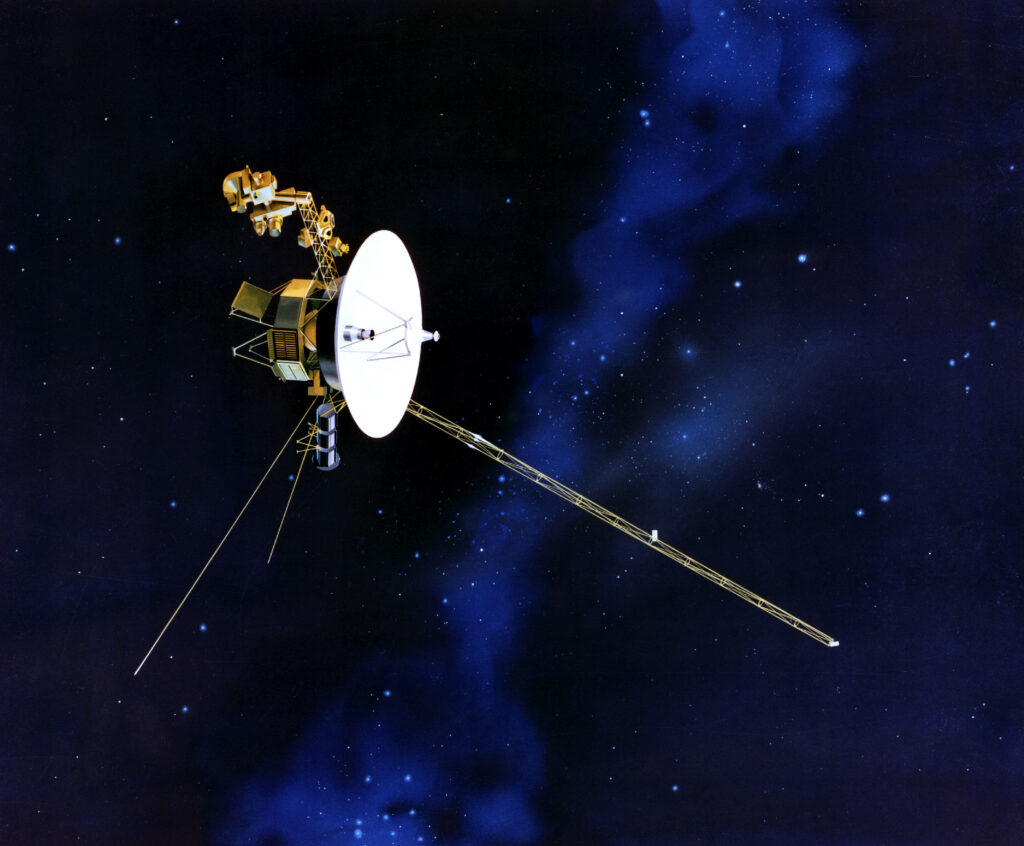
NASA’s (National Aeronautics and Space Administration) unmanned space probe “Voyager 1” launched in 1977. In 1990, 13 years after its launch, it flew at a speed of 64,000 km/h in space, near the edge of the solar system, at an astonishing distance of about 6 billion kilometers from Earth (Note 1, Fig. 1). It was during this time that astronomer Carl Sagan, who had been involved in the Voyager program from the beginning, pointed the Voyager 1 camera at Earth, even though it was not included in the original plan for the mission. He suggested that NASA should take another picture of the Earth from a distance at the edge of the solar system.
(Note 1)Voyager 1 is still exploring the solar system and interstellar space 46 years after its launch. As of October 2024, it is located at about 24.9 billion kilometers from Earth, the most remote object ever made by humans, and continues to travel beyond the solar system.
From February 14 to June 6, 1990, Voyager 1 took 60 photographs and transmitted them to Earth. In one of them, the Earth, which was only a tiny dot of 0.12 pixels relative to the vast universe, was vividly captured as a dim blue dot on a grayish background. The photograph was named “Pale Blue Dot” because of the color of the Earth in which it was taken, and to date it is a photograph of the Earth taken at the farthest point from the Earth.
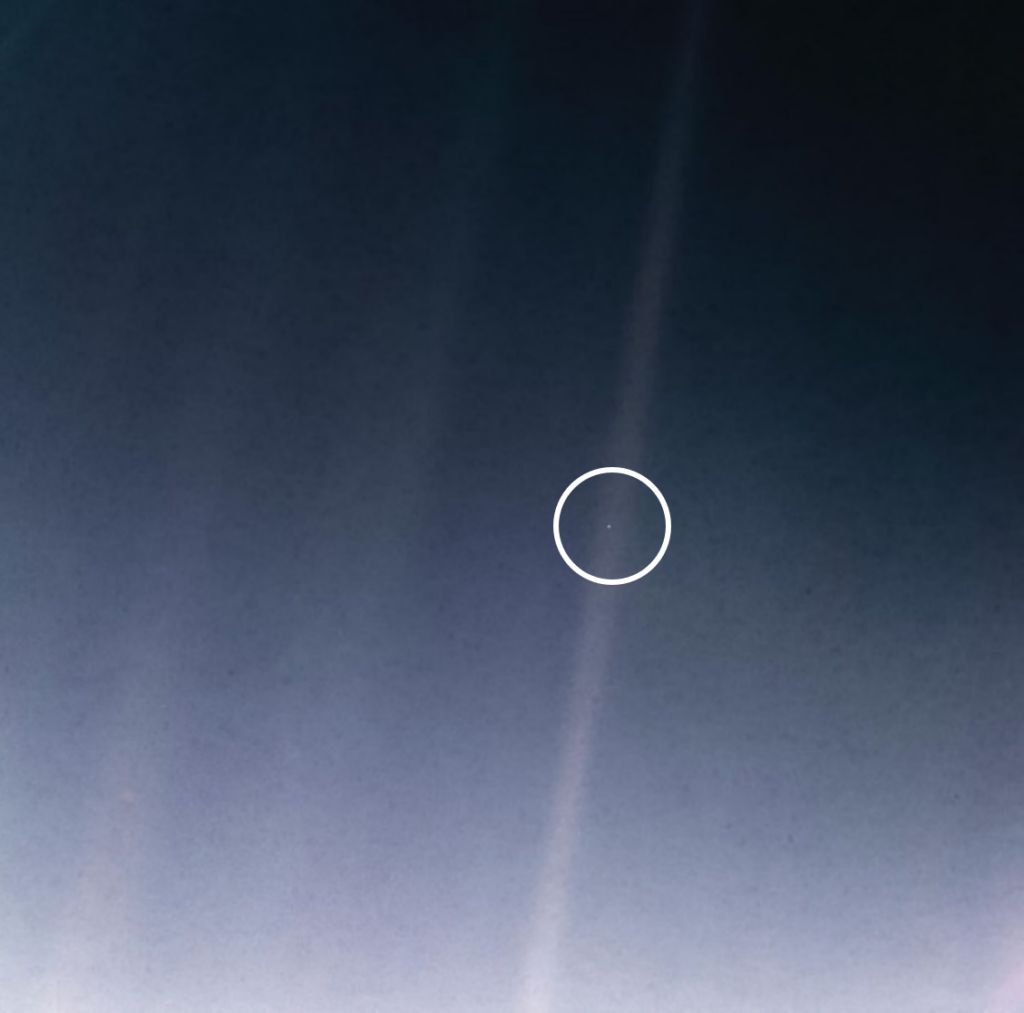
From the position where Voyager was flying, the Earth was only a tiny blue dot, the only thing that stood out against the vast black cosmic background. The faint dot is difficult to find without careful searching, and the photographs in “Pale Blue Dot” show that we are all very small beings in the infinite darkness, living beings with a shared destiny. We exist on the abyss of the infinite universe, on its lonely point, and we have nothing to rely on but ourselves.
We, the “modern humans,” have clung to the Earth, which is a tiny existence in the infinite darkness of this universe, and have evolved in a kind of dangerous but solid system and built our own civilization. Now, we are entering the “era of robots and artificial intelligence,” and the pace of technological progress is increasing at an accelerating pace. We are taking a step toward the realization of “Artificial General Intelligence (AGI),” a system that can affect our own existence.
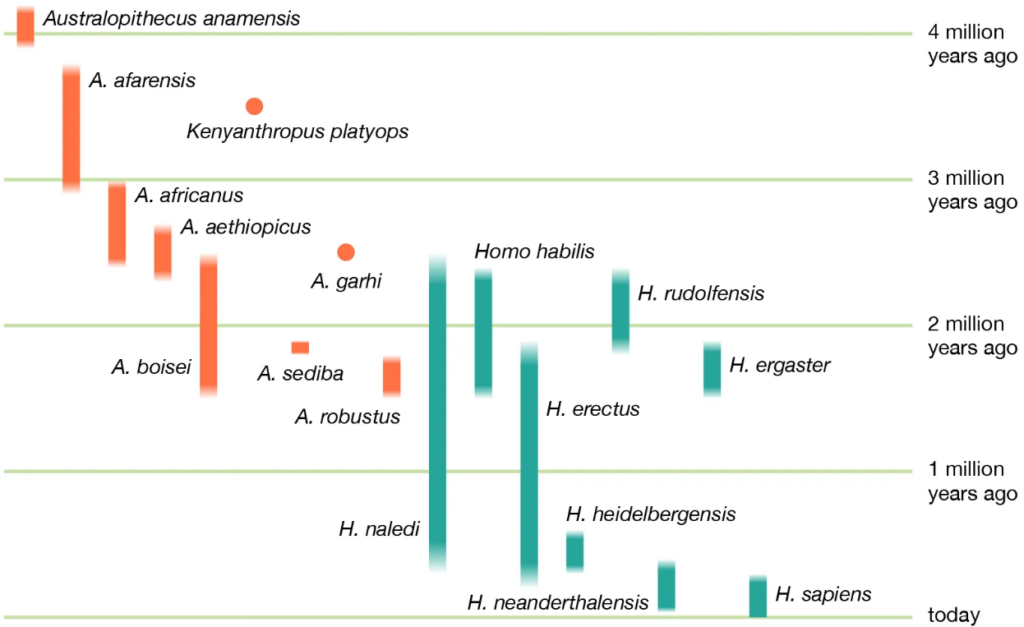
So how did our history, which has given rise to such an advanced civilization, begin? If we look at the outline of the genus Homo from its birth to the present, including modern humans, we can see its abyss. The “genus Homo”, also known as the “human genus”, is a subgroup of the family Hominidae within the order Primates of mammals. It includes “Homo sapiens”, the species to which modern humans belong, as well as the ancestral species from which they evolved.
The story of the evolution of our civilization began with the use of the first technology, “fire”.
We don’t know exactly when humans, who existed in isolation, began to use fire. However, after the advent of “Homo sapiens”, evidence has been found that it was already widely used 100,000 years ago. In addition to such physical evidence, the “story of Prometheus” in ancient Greek mythology contains an “ancient memory” of how fire dramatically changed human life. Fire was the first “multifunctional technology” in human history. The fire served as a source of light and also provided safety by keeping animals away. The fire was mobile and allowed migration to colder regions. However,
- the most significant effect of fire was the acquisition of the ability to ‘cook’ food.
By heating the food, the available calories increased exponentially. For example, when meat is heated over a fire, not only does it make it easier to chew through the meat, but it also breaks down the proteins in the meat and makes them easier to digest. In addition, the use of fire made it possible to break down indigestible cellulose and starch, making it possible to use various plants that were previously inedible as food. What you mean,
- fire has made it possible to “outsource” some of the digestive processes in our bodies
Even if raw ingredients are ingested, most of them pass through the body undigested, so it is extremely difficult to live on raw foods alone.
So what did our ancestors use these large amounts of calories for?
It is an application to “brain development”.
We have used these energies to form a complex brain that no other organism can match. In a short period of time, humans have acquired about three times as many neurons as the brains of gorillas and chimpanzees.
The brain, with its astonishing complexity, can be likened to the supercomputer “Fugaku”, for example. When operating at full capacity, Fugaku consumes 30 megawatt-hours of electricity per hour – an amount equivalent to approximately 75 months’ worth of electricity used by an average four-person household in Japan. Similarly, we use 20% of our total calories burned only to maintain this highly developed brain. Few organisms would devote even half of this energy consumption to maintaining intelligence, and from the standpoint of survival, this was a bold gamble.
However, its evolution has been happily rewarded.
We have created a new technology, “language”. The acquisition of this language is a great leap forward in human nature, and it can be said that “language has made mankind human.” With the acquisition of language, we have built “cities”, cultivated “crops”, created “writing”, and built civilizations.
Looking at the progress of human prehistory, we can see that “fire” was the starting point of a long story of humanity and “technology”.
This “technology” acquired by mankind means the application of knowledge to matter, processes, and technologies, and was created primarily to enhance human capabilities. Thanks to technology, we can now do things that were once impossible, and what we can already do can be done more efficiently and easily. That is,
the acquisition of technology has given positive feedback to the evolution of mankind. This accelerated growth has led to the rise to the “heights of civilization” that can reach “artificial general intelligence (AGI)”.
However, this “height” refers to the ability to create systems with intelligence comparable to and in some cases surpassing the human brain, and can be said to be a kind of plunge into divinity. For this reason, at the stage when the appearance of AGI began to be dimly visible, people such as Stephen Hawking, Elon Musk, Bill Gates, etc., who in a sense, represented the intelligence of humanity, warned of the threat of artificial intelligence and pointed out the possibility that it could threaten the survival of humanity in the near future.
On the other hand, from this height, we have been able to uncover and understand the grand journey from the origin of the universe to the birth of the Earth, the origin and evolution of life, and to the modern human race, using the tools of science.
This story has been compiled with the hope that you, the young boys and girls who will bear the future of humanity, will understand and reacknowledge “the long and unbroken journey—from the formation of the present universe and the birth of the Earth, to the emergence and evolution of life, and ultimately to the present state of humankind”—revealed through the struggles and efforts of scientists. It is our hope that this understanding will serve as a foundation upon which you can reflect and determine the path you should take moving forward.
Each part of this story is heavily borrowed from the original (translated version) listed in the bibliography, and the originality is present in those books. If I have any originality, it may be in the fact that I have connected the themes described in each of the original works along a timeline and woven them together as a single “story.” Therefore, I would like to clarify that if there is a part of the description of each part that deviates from the content intended by the original work, it is due to my lack of competence.
Let’s start with the “birth of the universe”.
Section 1 The Birth of the Universe and its Composition
Chapter 1 The Birth of the Universe
Our universe is believed to have been born about 13.8 billion years ago.
The history of the universe was elucidated by the “Wilkinson Microwave Anisotropy Probe (WMAP)” (Note 2). Figure 4 shows an overview of its history.
(Note 2)WMAP is a space probe launched by the National Aeronautics and Space Administration (NASA) on June 30, 2001, whose mission is to investigate the temperature of the “Cosmic Microwave Background (CMB)”, the afterglow of the Big Bang, across the entire sky.
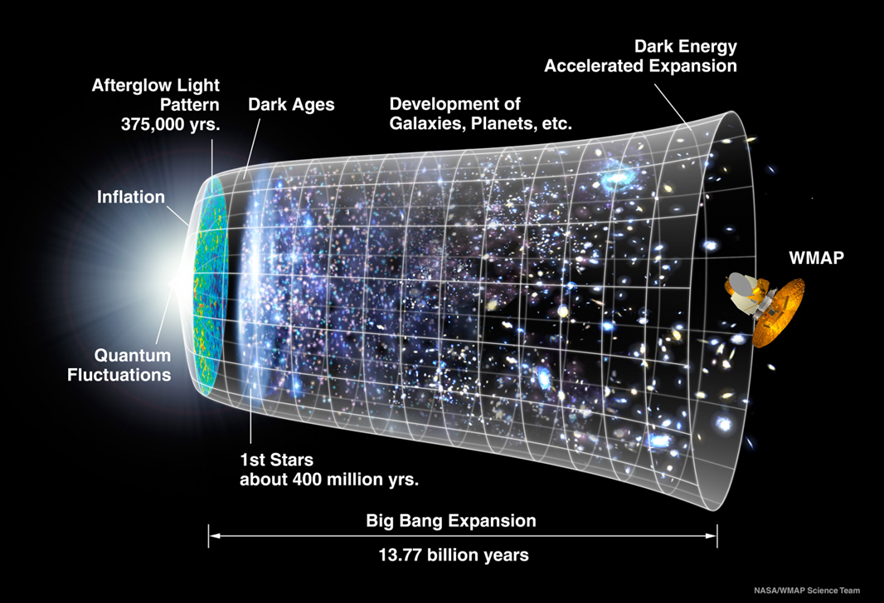
The origin of our universe was a spectacular explosion called the “Big Bang”.
However, current science does not know exactly what exactly triggered the Big Bang or what existed before it.
Luckily for us, the “traces of the Big Bang” still remain. Various clues and fragments persist, and by investigating them, we can explore the details of the Big Bang. Advancements in science, technology, mathematics, and physics over the past 50 years have laid the foundation for a scientific understanding of what the Big Bang caused. Theories related to the Big Bang can be tested through phenomena predicted from its remnants.
But even if it were possible, we didn’t fully understand the Big Bang and the events that preceded it. So, I would like to clarify what we do not currently understand about the Big Bang, but before we do so, I would like to start by talking about what we currently understand.
The Big Bang theory was proposed at the beginning of the 20th century.
At that time, all the galaxies observable from Earth were moving away, making it clear that the universe was expanding.
Cosmologists used the equations of “general relativity” to explain this observation and reinterpreted the concepts of space, time, and gravity. This made it possible to provide a concise explanation of the expansion of the universe, but it also raised new questions. If you go backwards in time and go back in time to the expansion of the universe, you will find surprising results. That is,
the conclusion is that the entire universe was concentrated in an extremely dense “singularity”. From this microscopic “seed” the current magnificent universe developed. It is a theory of the origin of the universe that we call the “Big Bang”.
When many people hear the word “Big Bang,” they usually think of it as a bomb exploding. It is natural to think that all matter in the universe is compressed into an extremely small volume, which spread in all directions to form the current universe.
But the idea that all beings once converged into one infinitely small point is far beyond our imagination. In fact, the phenomena that occurred during the Big Bang cannot be captured in simple images such as the explosion of a bomb. In fact, it is much more complex than that, and it is shrouded in “three great cosmic mysteries” that cannot be answered at the moment. Enumerating them,
- Mystery No. 1: Quantum Gravity
- Mystery No. 2: The universe is too big
- Mystery No. 3: The universe is too smooth
These are the three mysteries.
In order to get a little closer to the essence of the universe, let’s consider these three mysteries in order.
The Big Mystery of the Universe Part 1: Quantum Gravity
First of all, if we think about the moment of the birth of the universe, if this universe was once an infinitely small point, then everything in existence today existed at that one point. In other words, all of them occupied one place, and the volume was equal to zero. Although it is possible to reach this conclusion from the general theory of relativity, it is questionable whether it is really theoretically valid.
This is because since the development of the general theory of relativity in the early 20th century, it has become clear that the universe is a surprisingly strange place on a microscopic scale. It became clear that quantum mechanics, which obeys the counterintuitive law of probability, dominates the universe. When quantum mechanical effects become pronounced in a high-density state, predictions derived from the general theory of relativity become untenable. If, at the moment of the birth of the universe, matter was concentrated in a very small space, this was exactly the situation. Even if we rely on theories to make a rationale, we will not be able to elucidate everything in the end.
- General relativity and the Big Bang theory also do not hold for the primordial universe. Since we don’t have a “relativistic quantum theory” yet, we don’t really know how to calculate or predict what happened in the universe immediately after birth. Therefore, the image that the Big Bang began with a singularity may not be accurate. Immediately after the birth of the universe, it is thought that the effects of “quantum gravity” were widespread, but we do not know how to express it at all.
This is the first mystery.
The Big Mystery of the Universe Part 2 : The Universe Is Too Big
When we think of the Big Bang, we generally think of an infinitely small point exploding, but there is a problem with that. Whether the universe grows from an infinitely small point or from a small quantum blotch, it may not match the actual state of the universe at all. No matter how large the universe becomes, it does not match the scale of the actual universe.
“The universe is too big.”
To illustrate this, let’s first consider how far we can see the universe. Suppose we have a telescope that looks at a distant star and captures the light that reaches our field of view from that star. How far the telescope can see depends on the age of the universe. This is because the act of looking at something means that the photons that start from the object we are looking at reach our eyes (or telescopes). There is a limit to the speed of photons, and the speed of light cannot be exceeded. Thus, when we see a distant object, it takes time from the moment the photon leaves until we capture it. For this reason, how far we can see depends on how much time has passed since the universe was born.
For example, if we assume that the universe was born 5 minutes ago, the maximum visible distance is about 90 million kilometers at (the speed of light) × (5 minutes). This is about the distance to Mars. This range is called the “observable universe.” All objects we can observe are contained in a sphere whose radius is the range that light has been able to reach from the birth of the universe to the present. Photons that departed from the surface of this sphere at the birth of the universe are about to arrive at us. This is how the range of our vision is determined.
Light from stars, planets, and other objects outside this sphere has not yet reached us. Therefore, no matter how powerful the telescope is, it is impossible to observe them. Even if it is a superbright supernova, if it exists outside the sphere, we cannot see it.
Over time, this sphere expands outward, allowing us to see a wider area of the universe. As light from distant celestial bodies reaches the area, the field of view expands year by year. Information about the state of distant celestial bodies arrives at the speed of light, and the limits of our vision expand at the speed of light.
However, on the other hand, all objects in the universe continue to move away from us, and there is a kind of chase between the limits of vision and the target object of the telescope. It’s even more interesting to see how close this chase is, given the fact that while the limits of vision are expanding at the speed of light, the contents of the universe can’t move faster than light due to the theory of relativity.
If we assume that everything in the universe starts from a quantum point of minute but constant size, and has been moving simply in space since the Big Bang, then our “limits of vision (the horizon)” will expand at a faster rate than stars and other beings in the universe, and distant vision will gradually become apparent. And in a short time, the limits of our vision will expand beyond the entire universe, and the horizon will be larger than the universe itself. If that happens, what can we see? When the horizon crosses the entire universe, the other side of the point where “there are no stars beyond here” will be visible. In other words, it should be possible to see empty places, or “places where the stars break”. However,
- No matter which way you look, there is no place where such stars break off. Despite the fact that the universe has been around for about 14 billion years, it is still far larger than the limits of our vision. The notion that all cosmic beings start from a small mass and simply continue to expand in static space is something fundamentally incomplete.
The Big Mystery of the Universe Part 3: The Universe Is Too Smooth
The idea that the Big Bang caused the entire universe to begin to expand from tiny points is yet another problem. It is a problem that “the universe is too smooth”.
The universe may seem messy at first glance, but in fact it is uniform and smooth throughout. Its smoothness can be confirmed by observing the Cosmic Microwave Background (CMB) (Note 3).
(Note 3) Microwaves observed almost isotropically from all directions on the celestial sphere. Its spectrum is in very good agreement with the blackbody radiation at 2.725 K. The discovery of the cosmic microwave background (CMB) is a remarkable story in the history of astronomy. In 1964, two physicists at Bell Labs, Arno Penzias and Robert Wilson, were testing a new, highly sensitive horn antenna for radio astronomy observations. The two noticed that the antenna was recording a faint but continuous noise. After a thorough investigation of all possible sources of this radio noise, including radiation emanating from pigeon droppings, Penzias and Wilson came to the following conclusions: This signal originates from the natural world and comes from all directions in the entire sky. Meanwhile, at the same time, cosmologists were looking for such signals. The true identity of the signal was predicted to be the “afterglow” of the Big Bang. Even now, over ten billion years after the Big Bang, the remnants of this hot state are believed to be reaching beyond stars and galaxies and from the farthest reaches of the universe that can be observed. Rumors of the discovery by Penzias and Wilson soon reached the ears of Princeton University physicist Robert Dicke. For Dicke, it was intuitively understood that this was the cosmic radiation he had been looking for for a long time.
The cosmic microwave background radiation is a microwave that is observed almost isotropically from all directions on the celestial sphere, and its temperature can be measured. Surprisingly, when we measure the temperature of photons in the cosmic microwave background radiation reaching the Earth from one direction and compare it with the temperature of photons arriving from the other side, the temperature is the same about 2.725 K [-270.42°C] no matter which direction it is turned. Its spectrum, arriving from either direction, is very well matched to the blackbody radiation of 2.725 K. That is, the presumption that the entire universe is at the same temperature is applied.
To understand why this fact challenges the simple Big Bang theory, we must first understand what the photons of the cosmic microwave background are. The photon is actually delivering the first “picture” of the universe. The newly born universe was much hotter and denser than it is today. In extremely high temperatures, atoms could not be formed, and all substances were ionized and existed in the form of plasma. Electrons, flying around with too much energy, were unable to combine with positively charged atomic nuclei to form atoms. However, as space cooled, the situation changed rapidly. The temperature dropped, the charged plasma turned into a neutral gas, and the electrons began to revolve around the proton, forming atoms. As a result, light was able to fly around freely, and the universe, which had previously been opaque because light could not fly around freely, became “transparent”.
In the previous plasma state, photons collided with electrons and ions that moved freely with only a slight advance. However, when electrons and protons (and neutrons) formed neutral atoms, photons could fly around more freely, as photons rarely interacted with atoms. To the photon, it was as if the hazy universe had suddenly become clear and transparent. Since then, the universe has continued to cool, and most of its photons are still flying.
The measurable cosmic microwave background radiation is its photon. Interestingly, the temperature of its photons seems to be the same everywhere. Photons of the same energy are observed in any direction. This indicates that the cosmic microwave background radiation is extremely uniform.
It is presumed that such a result can be obtained by homogenizing over a long period of time and leveling the hot part. However,
- photons in the cosmic microwave background radiation are very old. It is a photon that was created about 14 billion years ago, just after the Big Bang. If you look in one direction in the night sky, you can see photons that were created in the far distance about 14 billion years ago. If you look in the opposite direction, you can see photons that are also produced far away. Why do they have the same energy, even though they came from opposite ends of the universe? Could the photons have actually mixed and exchanged energy to become uniform? They would have had to exchange information faster than the speed of light, which seems strange.
These are the observations currently obtained, as well as the accompanying “three great cosmic mysteries”.
An explanation consistent with these observations was proposed in 1981 by Katsuhiko Sato of the University of Tokyo, followed by Alan Goose of the Massachusetts Institute of Technology in the United States (Note 4).
(Note 4)K. Sato, “First-order phase transition of a vacuum and the expansion of the Universe”, Monthly Notices of Royal Astronomical Society, 195, 467, (1981)
A. H. Guth, “The Inflationary Universe: A Possible Solution to the Horizon and Flatness Problems”, Phys. Rev. D 23, 347 (1981)
In a nutshell:
- During approximately 0.00000000000000000000000000000001 seconds (a decimal point followed by 31 zeros) after the birth of the universe, “space-time itself” expanded at a speed exceeding that of light by a factor of about 10,000,000,000,000,000,000,000,000 (ten septillion times). However, when we say that it is faster than light, it does not mean that objects in space move faster than light, just because a new space has emerged and the distance has increased at a speed greater than the speed of light. This theory is called the “inflation theory”.
This astonishing expansion, or “inflation”, which occurred almost instantaneously, solves two of the “three great cosmic mysteries” that currently exist [Mystery 1: Quantum Gravity, Mystery 2: The Universe Is Too Large, Mystery 3: The Universe Is Too Uniform], 2 and 3. Amazingly, this expansion continues to this day. “Dark energy” continues to create new spaces.
Recently, the theory of inflation has moved away from abstract mathematical theories and is being demonstrated by observations, although it has not yet been fully proven. If we can observe the “gravitational waves” generated by inflation, it will provide more direct evidence. Here are the details:
Inflation Theory
If we assume that the universe began as a tiny blob immediately after the Big Bang and that the whole simply expanded in space, we cannot explain the essential problem that the universe as we perceive it is too “too big” and “too smooth.” However, a convincing but implausible solution to the problem was proposed. This is the theory of inflation.
As I said earlier, if,
in the short time immediately after the birth of the universe, approximately 10-32 seconds (31 decimal “0s”), “space-time itself” expanded by about 1025 times ( ten septillion times) at a speed far exceeding the speed of light
If so, what do you think? However, “faster than light” means that the newly created space has expanded at a speed that exceeds the speed of light, and it does not mean that objects have moved faster than light in space. According to the theory of relativity, objects in the universe cannot move faster than light in space.
First of all, how will the “mystery 2 that the universe is too big” be solved?
The problem was that the observable universe was still small, even though the observable universe was expanding at the speed of light, while the entire actual universe was expanding slower than the speed of light. However, according to inflation theory, the universe expanded beyond the speed of light for a very short period of time.
Objects in space always comply with speed limits. That is, an object does not move faster than light in space. However, according to inflation theory, at the moment of the birth of the universe, “space-time itself” expanded, and new space increased at a speed that light could not keep up with. As a result,
the universe, which started out as a tiny blob, is now much larger than the observable universe due to this inflation. While inflation was underway, the universe continued to expand, leaving its horizon far behind. As a result, the light emitted by objects that have been driven away has not yet reached us. The expansion of space was astonishing. In a short period of 10-32 seconds, the universe has grown more than 1025 times larger. Even after inflation ends, the universe continues to expand. At first, the rate of expansion was relatively slow, but in recent years the rate of expansion has increased due to the influence of dark energy. On the other hand, the range of the observable universe continues to expand at the speed of light, leaving a small chance of catching up with the entire universe. However, we do not yet know the full extent of the universe beyond what is observable.
Next, how can inflation solve the “problem of the universe being too smooth”?
In order to explain the uniformity of the temperature of photons, we have to look for a mechanism by which ancient photons (photons from opposite ends of the universe) mix and become the same temperature. To do this, it is necessary to assume that these photons were much closer in the distant past than would be expected from the current rate of expansion of the universe.
According to inflation theory, these photons existed in close proximity to reality before the rapid expansion of space-time. Because the universe was so small before inflation, there was enough time for all the photons to interact and achieve temperature equilibrium. However, when inflation began, these photons were separated from each other. They are so far apart that it seems to us that “they cannot be the same temperature”, but it is reasonable to assume that they were in fact very close before inflation.
Thus, by means of a huge expansion that occurred in an instant, or “inflation,” these questions can be resolved.
But the question remains, however, how can we confirm what happened about 14 billion years ago?
In fact, according to inflation theory, there is clear evidence for minute fluctuations “ripples” in the cosmic microwave background radiation. It is still observable today, and indeed some evidence has been found. An example is shown in Fig.5 (Note 5) .
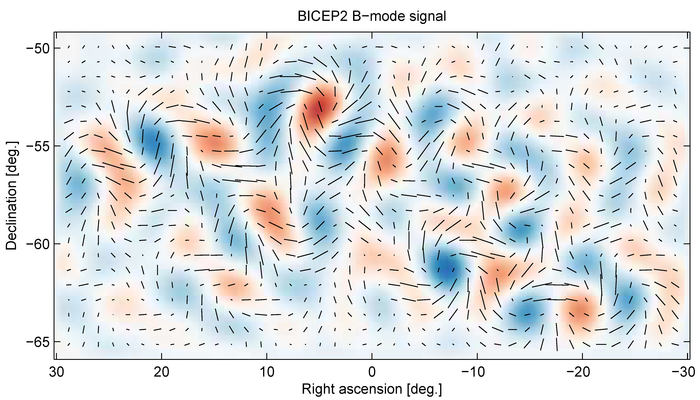
(Note 5) Researchers at the Harvard-Smithsonian Center for Astronautical Physics, as an international collaborative research group led by the United States, have observed the “cosmic microwave background radiation” that has reached the Earth since the early days of the universe with a radio telescope located near the South Pole, and detected traces left by gravitational waves in the cosmic microwave background radiation for the first time. It is thought that the universe was born about 13.8 billion years ago at a very small size, and inflation occurred immediately afterwards, followed by the Big Bang (fireball universe), and gravitational waves were generated with inflation. What was observed this time is the trace of gravitational waves that have continued to spread as “ripples” left about 380,000 years after the birth of the universe. This very trace serves as definitive evidence supporting the occurrence of inflation.
Of course, there are other theories that have the potential to produce similar “ripples,” so this evidence alone cannot be definitively correct in its entirety, but it is becoming more convincing.
In fact, the very fact that the universe was born about 14 billion years ago was also revealed through these “ripples”. From these “ripples”, we can calculate the proportion of matter, dark matter, and dark energy in the universe, and by combining them, we can determine the expansion rate of the universe. And from there, we can estimate the age of the universe.
We had to come up with a tremendous, seemingly unbelievable momentary expansion of space-time, but according to observations, it seems that “inflation” did indeed occur.
However, there is still one problem. “What caused inflation” is not disclosed.
We don’t know which factors could be responsible for the sudden expansion of space-time in the small universe. The mystery of inflation is still profound, and it is only beginning to become clear what the problem is.
Chapter 2 The Composition of the Universe
As for the immediate aftermath of the birth of the universe, its appearance is gradually becoming clear, albeit vaguely. So, what does the universe consist of?
1.What is the universe made of?
The substances we come into contact with in our daily lives are made up of “atoms” of the elements shown in the “periodic table”. Each atom is surrounded by a cloud of “electrons” around the “nucleus”, and there are “protons” and “neutrons” in the nucleus. Protons and neutrons are also composed of “up quarks” and “down quarks”.
Thus, as long as there are up and down quarks, as well as electrons, it is possible to generate any element on the periodic table. The countless components once thought to make up the universe were eventually reduced to just over a hundred elements arranged in the periodic table, and then further simplified to only three types of particles. It shows that anything we can see, touch, smell, and in short, feel with our five senses is made up of these three types of particles.
This recognition is the product of the collective knowledge and efforts of millions of people.
However, this commentary overlooks two major aspects. At first,
in addition to the three types of particles that form matter, there are several other particles. In the 20th century, in addition to these three types of particles, nine more types of material particles and five types of particles that transmit force were discovered.
Among them are some truly mysterious particles. For example, it contains peculiar particles such as “neutrinos”, which can pass through trillions of kilometers thick of lead without a single collision. There are also particles that are similar to the three types of particles that make up matter, but are much heavier.
- The significance of these particles, and what other particles exist, is not yet fully understood.
Another important point is the fact that the three types of particles that make up stars, planets, comets, and everything around us are only a small part of the composition of the entire universe.
- The matter that we come into contact with on a daily basis, that is, the matter that we have knowledge about, is actually a relatively rare entity in the entire universe. These substances account for only about 5% of the total mass and energy of the universe. So what is the other 95% that makes up the universe? This is still not fully understood.
If you show the components of the universe in a pie chart, you will get the following mysterious composition.
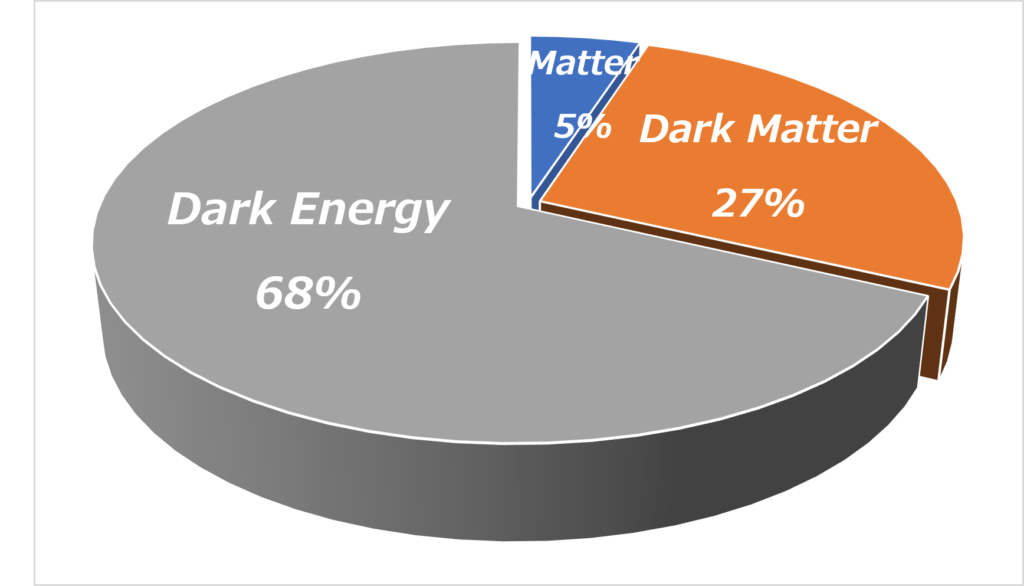
Only about 5% of all the substance in the universe—the stars, planets, and everything on their surfaces—is the familiar matter we know. 27% is an unknown entity called “dark matter,” and the remaining 68% is “dark energy,” whose nature is largely a mystery. It is this dark energy that is believed to be driving the expansion of the universe.
To make matters worse, there is still much that is not yet understood about the 5% of substances that we know. Not all of the phenomena in which there are many more particles in addition to the three types of particles that make up matter are understood.
This, for the time being, is the best possible answer to the question, “What is the universe made of?” We have entered an era in which our understanding of the universe is rapidly evolving, and cutting-edge scientific instruments—such as powerful particle accelerators, gravitational-wave detectors, and telescopes—are being deployed and put to work in the effort to uncover the answer.
2.What is dark matter?
Let’s consider the question of what “dark matter” is.
From the point of view of modern physics,
about 27 percent of the matter and energy in the universe is understood to be composed of a substance known as “dark matter”. This shows that most of the matter in the universe is of a different kind of matter than what we have known through centuries of observation and research. This mysterious substance exists in five times the amount of material we see on a daily basis. Therefore, the matter that we perceive is actually quite rare on the scale of the universe.
Dark matter is everywhere in the world we live in, and we actually live in it. The existence of dark matter was first discussed in the 1920s. In the 1960s, observations of the rotation of galaxies and investigations into their masses led to the existence of dark matter being taken seriously. The circumstances that led to this are as follows.
Astronomers first tried to estimate the mass of galaxies based on the number of stars. However, when the values were used to calculate the rotational speed of the galaxy, the results did not match. In fact, the observed rotational speed was higher than the speed estimated from the number of stars. In other words, like a ping-pong ball on top of a merry-go-round, based on the observed rotational speed, they have concluded that it would be strange if the star did not leap off the edge of the galaxy. In order to account for this unexpectedly high rotational speed, it was necessary to significantly increase the mass of the galaxy used in the calculations and retain all the stars. However, when they searched for its mass, they could not find it.
To resolve this contradiction, the hypothesis was put forward that there is a large amount of something heavy and invisible “dark” in the galaxy. This strange mystery has not been solved for decades, but as the years have passed, this invisible and heavy mystery has gradually come to be accepted as “dark matter.”
There is another important clue that dark matter has been recognized as definitely present. It is a phenomenon called “light bending”, that is, “gravitational lensing”. This phenomenon occurs when a heavy object exists between the Earth and the galaxy, and the space around the object is distorted, causing the light particles to curve in the direction of the Earth. This phenomenon of light bending due to gravity was predicted by Albert Einstein and subsequently confirmed.
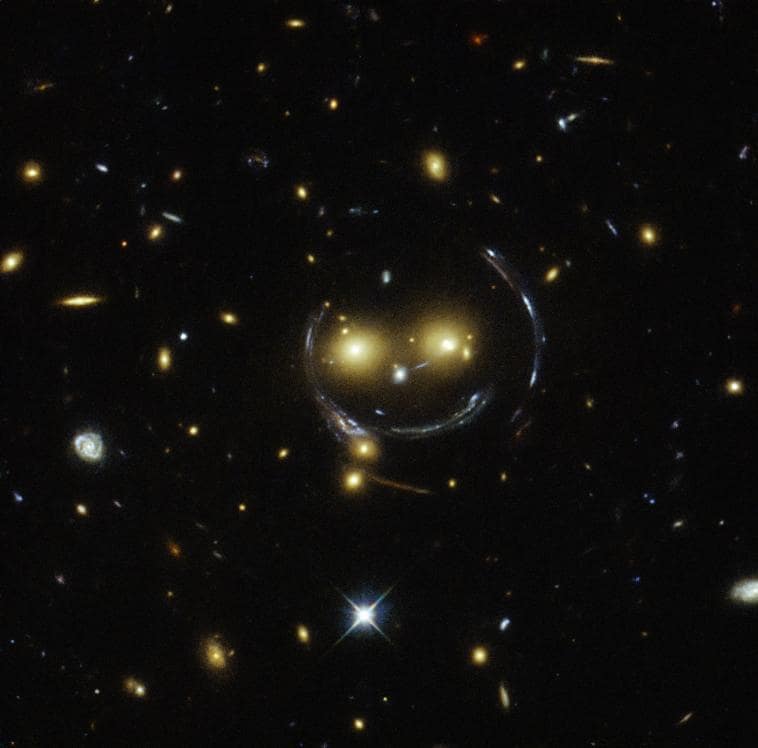
due to the influence of gravitational lensing
If there is something heavy and invisible between the Earth and its galaxy, it is understandable that one galaxy would appear to be two. The heavy, invisible mass acts like a large lens, bending the light from the galaxy, so that the light appears to come from two directions. In fact, when we on Earth look through a telescope, we sometimes see the same galaxy in two directions in the night sky. Since this phenomenon was observed in various parts of the night sky, it was assumed that this heavy, invisible substance was present everywhere.
In the end, the most convincing evidence was found in the observation of large-scale “galactic collisions”. Millions of years ago, a major event occurred in which two clusters of galaxies collided. When two clusters of galaxies collided, gas and dust collided, causing a spectacular event. A huge explosion broke apart a huge cloud of dust, and astronomers made important discoveries. Near the site of the collision, they found two huge chunks of dark matter (Note 6). Of course, dark matter is not visible, but it can be detected indirectly by measuring the distortion of light from galaxies beyond. Two clumps of dark matter were observed to slip past the site of the collision as if nothing had happened.
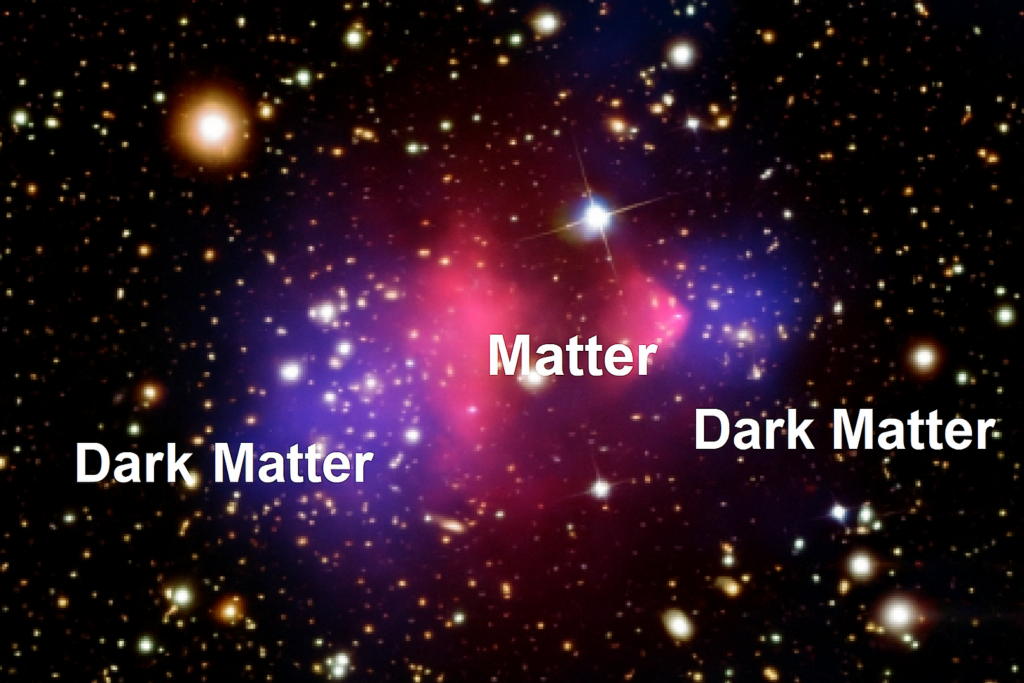
(Note 6) The blue part: “Dark matter that transmits and flies away” visualized by reconstructing the distribution location using gravitational lensing, and the red part: Ordinary materials that collide and emit X-rays (X-ray observation)
This phenomenon can be interpreted as follows.
In the beginning, there were two clusters of galaxies consisting of both ordinary matter (mainly gas and dust, and a little star) and dark matter. When the two galaxy clusters collided, most of the gas and dust collided as normal matter. However, nothing detectable happened between the dark matter. The chunks of dark matter continued to move on, slipping past each other. As if you can’t see the other person. And the stars, too, were so sparsely dispersed that they slipped through almost untouched. Clumps of matter larger than galaxies slipped through each other. As a result, the collision ended with only the removal of gas and dust from the galaxy.
Dark matter isn’t hiding somewhere. They form large clumps, drift in space, and chase galaxies. That’s why it’s highly likely that at this very moment we are under siege by dark matter, and it should also be passing through your body.
But why is it so difficult to see and touch dark matter, even though it is presumed to be ubiquitous, and so difficult to investigate? The reason for this is that dark matter has little interaction with us. It has been confirmed that mass exists (meaning “matter”) even though it is invisible (meaning “dark”).
Before we explain why this is possible, let’s first consider how ordinary substances interact with each other.
The action between substances occurs mainly with the following four forces.
- “Gravity”: The force of mutual attraction between two objects with mass
- “Electromagnetic force”: The force acting between two particles that have an electric charge. Depending on whether the plus or minus of the charge is different or the same, it becomes an attraction or a repulsive force. Light, and of course electricity and magnetism, are also functions of electromagnetic forces
- “Weak nuclear force”: It has many similarities with the electromagnetic force, but is much weaker. For example, neutrinos act weakly with other particles through this force. In the state of ultra-high energy, the weak nuclear force becomes the same strength as the electromagnetic force, and becomes a single force called the “electroweak force”
- “Strong nuclear force”: The power that binds protons and neutrons together in the nucleus of an atom
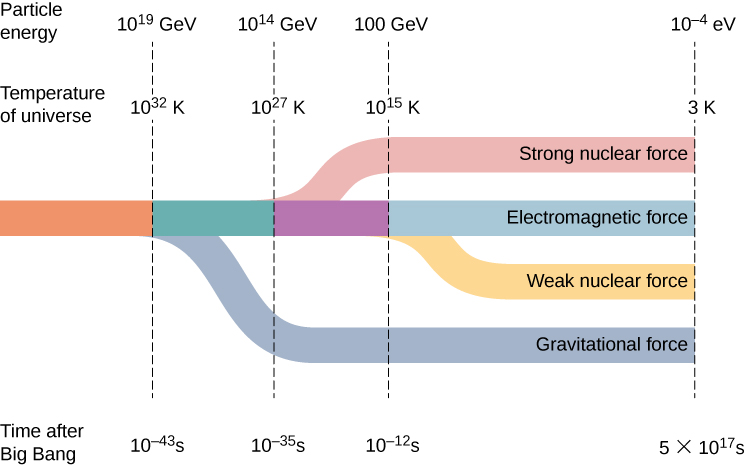
The reason for the existence of these four types of forces is not yet conclusively understood. These are listed based on observations, but as it stands, all experimental results in particle physics can be explained by these four forces.
So why is dark matter “dark”? As mentioned above, dark matter also has mass, so it feels gravity. But that’s where dark matter goes. It is speculated that it will not feel the electromagnetic force. Therefore, it does not reflect or emit light, making it difficult to observe directly. In addition, it does not seem to feel weak or strong nuclear forces. Therefore, until new interactions are discovered, it can be said that dark matter does not interact with our bodies, telescopes, or detectors through normal mechanisms, which makes it difficult to investigate.
Of the four basic interactions we are aware of, only gravity can be asserted to affect dark matter. This is where the word “matter” in dark matter comes from. Dark matter does indeed have substance and has mass, so it feels gravity.
There is certainly something out there. And that something,
- prevent the stars from flying into outer space,
- bend the light coming from the galaxy.
- In addition, it slips through the huge collision of space as it is.
So, what exactly is this “dark matter” made of? Certainly, the existence of dark matter and its approximate distribution are known, but it is not clear what kind of particles it consists of, or even whether it is a particle.
One hypothesis has been proposed for this question.
- Dark matter is a type of new particle that acts very weakly with ordinary matter through a new force
This is the theory. This hypothetical particle is called “WIMP,” an acronym for “Weakly Interacting Massive Particle” (wimp means “sissy”). The WIMP is thought to act very weakly with matter as we know it, through a new force. The intensity of its action is estimated to be about the same as that of neutrinos.
It is not known whether these hypothetical dark matter particles interact with ordinary matter with forces other than gravity, but for the time being, various experiments are being investigated to detect this hypothesis. Methods have been devised to detect dark matter, including placing compressed and cooled noble gases (such as xenon) in a container surrounded by detectors to capture collisions between dark matter and the gas atoms; using high-energy particle colliders to accelerate and smash ordinary matter particles (such as protons and electrons) at high speeds in order to create dark matter; and aiming telescopes at regions where dark matter is expected to be densely concentrated (such as the center of the galaxy) to investigate energy distributions that indicate particle collisions.
The truth of the universe is still largely a mystery, and dark matter is thought to be the key to solving that mystery. However, current mathematical and physical models of the universe do not include dark matter. We still don’t know for sure what it is that exists in large quantities and quietly draws us in.
3.What is dark energy?
Sixty-eight percent of the universe is made up of what physicists call “dark energy.” Despite the fact that it occupies the largest part of the universe, little is understood about its essence. All we know is the fact that its energy is expanding the universe at an astonishing rate.
The discovery of dark energy was entirely accidental. Scientists were trying to investigate how much the expansion of the universe was slowing down. However, they realized that, instead of decelerating, the expansion was actually accelerating.
At the beginning of the 20th century, many people, including astronomers, believed that the universe was stationary and would continue to exist forever. It was not thought of as a changing universe. Stars and planets were supposed to stay in place forever. However,
- in 1929, Edwin Hubble discovered that galaxies are moving away from Earth in all directions, and that their speed is proportional to the distance from each galaxy to Earth.
The universe was stationary and not static, but expanding. And if the universe had been constantly expanding, the universe in the past would have been smaller than it is now. Going back to this conjecture, it is thought that at some point the entire universe was compressed into one tiny point. This point occupied the entire space. This is the “Big Bang Theory”.
If the universe has a beginning, is there an end to it? And if the end is coming, in what form will it happen? What will cause the end of the universe? In fact, “gravity” has long been considered as a possibility.
The explosion of the Big Bang scattered matter in the universe in all directions, but gravity works the other way. Gravity acts on all matter, trying to return the universe to its original small state. There are three possible scenarios for the end of the universe. That is,
- the “Big Crunch Theory” in which there is enough matter and eventually gravity triumphs and the expansion stops, and everything begins to contract.
- The theory is that there is little matter, gravity does not stop expanding, and the universe continues to expand forever, and in the end, it becomes an infinitely faint and cold universe
- The theory that there is just the right amount of matter, and that the expansion slows down due to gravity, but the expansion does not stop or the universe does not contract, and the speed of expansion gradually approaches zero.
These are the three stories.
However, none of the above match the observations, and instead a surprising fact was revealed. That is,
- there is a powerful unknown force that expands space itself, and the universe is expanding at an accelerated rate due to this force
It was this fact. This was truly unexpected. Therefore, in order to predict the ultimate fate of the universe, it is necessary to understand the current rate of expansion of the universe. Scientists measured how fast the galaxy continues to move away from Earth.
It should be noted here that this expansion phenomenon does not mean that all celestial bodies are moving away from the center of the universe, but that all celestial bodies are moving away from all other celestial bodies. For example, when a raisin bread is baked and expands, all the raisins move away from all the other raisins. This is what is happening now.
In order to understand the fate of the universe, we need to know how the rate of expansion changes over time. Are galaxies moving away slower or faster today than they were billions of years ago? What is important is how the rate of expansion is changing over time. To find out, we need to measure how fast galaxies have moved away in the past and compare them to the speed at which they are moving away now.
In fact, it is extremely difficult to predict the future. However, it is relatively easy for astronomers to look into the past. As many of us already know, the light coming from a very distant star is very old. The information transmitted by that light is just as old. This is because observing the light is synonymous with the act of going backwards in time and looking at the past. Therefore, the farther away the celestial body, the older the light can be observed, and the more it is possible to explore the past. In addition, if a distant object moves away at a constant speed, and a relatively close object moves away at a different speed, then from this fact it is possible to deduce that the rate of expansion has changed over time. The speed at which a star is moving away can be measured by the displacement of the spectrum of light, or the “Doppler effect,” which is a shift in the spectrum of light. The farther away the star goes, the more the light shifts to the longer wavelength side, and the redder it appears.
In addition, in order to see how far away the celestial body is, astronomers have used the “Type Ia Supernova” (Note 7) called the “Standard Light Source (Standard Candle)” (Note 7 ) is used. By using this standard light source, we can determine how far away (and how old) a celestial object is, and the Doppler effect reveals how fast it is receding. Therefore, by using this information, it is possible to measure how the expansion rate of the universe has changed.
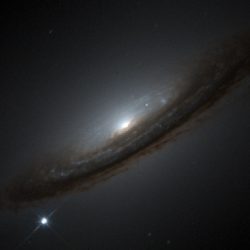
(bright dot in the lower left)
(Note 7) The phenomenon in which a star explodes brightly at the end of its evolution is called a “supernova explosion”. “Supernovae” are further divided into “Type II” in which hydrogen spectral lines can be observed and “Type I” in which hydrogen spectral lines are not observed, but those in which silicon spectral lines can be observed in Type I are called “Type Ia”. “Type Ia supernovae” are empirically known to have a nearly constant “peak luminosity” (absolute magnitude [supplementary note: the brightness of an astronomical object when observed from a distance of 10 parsecs, or about 32.6 light-years]). Using this property, it is possible to determine the distance to a supernova by creating a “luminosity curve” (Note 8) from monitor observations of type Ia supernovae, determining the absolute magnitude at maximum luminosity, and comparing it with the apparent magnitude. Because supernovae are so bright that they can be observed even at a distance, they are often used as distance indicators for distant galaxies.
(Note 8) A curve that shows the temporal variation of the luminosity of a supernova. The luminosity curve of a supernova generally reaches its maximum luminosity immediately after the explosion, then rapidly dims for several tens of days, and then slowly dims over 100 days, but the detailed shape varies from type to type. A “type Ia supernova” is a standard light source because its maximum luminosity is almost constant, which was used as one of the methods for determining the “Hubble constant” (if the distance to the galaxy is r and the recession velocity is v, the Hubble-Lemaître law is expressed by v = H0r, and its proportionality coefficient H0 is called “Hubble constant”).
The results obtained from these observations were completely unexpected.
- The fact that nearby stars (new stars) are moving away faster than distant stars (old stars) has been revealed. This indicates that the universe is expanding faster today than it did in the past.
This was a completely unexpected result for astronomers. The astronomer had only two facts in mind. That is, only “the explosion of the universe occurred a long time ago” and “gravity is trying to attract all celestial bodies.” Based on these two facts alone, it is impossible to assume that the universe is expanding faster today than in the past.
In fact, there was a third important entity hidden here. It is “space” itself.
- Space is not just a backdrop to the story of the universe. It is the existence of entities that bend (around heavy celestial bodies), ripple (gravitational waves), and expand. And indeed, it is expanding. Moreover, its expansion is accelerating. Something is constantly creating space, pushing everything in the universe outward.
- According to the actual results, the universe slowed down in the early days, but something has been expanding the universe at an accelerated rate since about 5 billion years ago.
- The driving force that drives the rapid expansion of the universe is what physicists call “dark energy.” It is invisible (meaning “dark”), but it has the power to push all objects (meaning “energy”), and its power is very powerful. It is estimated to be such a force that it accounts for about 68% of the total mass and energy of the universe.
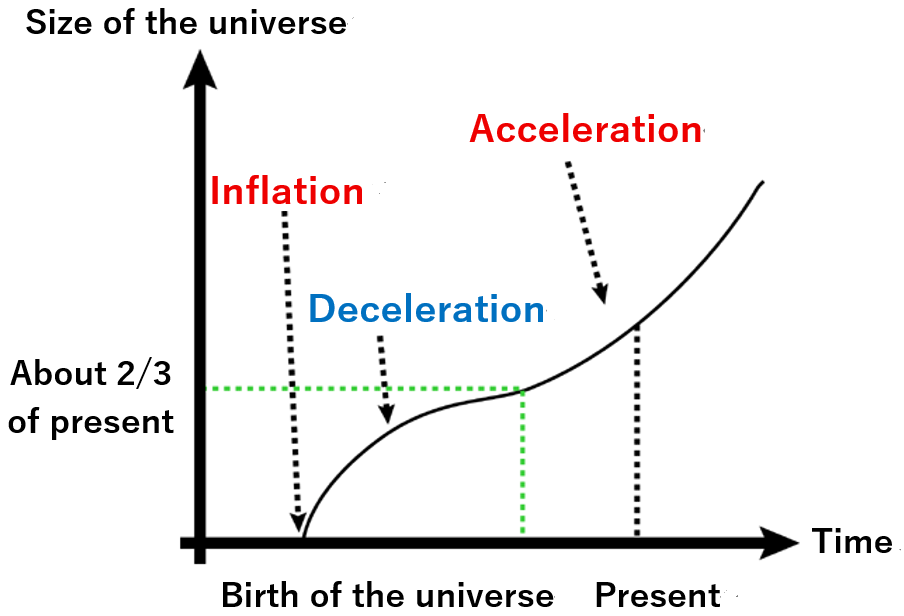
By the way, we have shown the ratio of “dark matter” and “dark energy” in concrete terms, but how can we calculate how much “dark matter” and “dark energy” there are in the universe? In fact, surprisingly, there are multiple ways to measure the percentage of dark matter or dark energy whose identity is not yet known. The following three specific examples can be cited.
- First, there is a way to investigate the image of the “cosmic microwave background radiation”. The number and pattern of wrinkles in this image depends on the proportion of dark matter, dark energy, and ordinary matter present in the universe. The pattern obtained from the images can only be explained by about 5 percent of ordinary matter, 27 percent of dark matter, and 68 percent of dark energy. It can be said that this method is very accurate.
- Next, there is a method to measure the expansion rate of the universe using “Ia-type supernovae” to measure dark energy. After estimating the amount of ordinary matter and dark matter, it is possible to calculate the amount of dark energy required for the universe to continue its current expansion.
- Finally, there is a method to investigate the current structure of the universe using computer simulations. Using this method, it is possible to reverse time from just after the Big Bang to the present and estimate the amount of dark matter and dark energy that was needed to form the universe as we know it today.
The results obtained using these methods are all consistent.
Regardless of the method used, it becomes clear that the universe is composed of ordinary matter, dark matter, and dark energy in a ratio of about 5 percent: 27 percent: 68 percent. Even though its identity is not known, its existence can be confirmed.
So, what is dark energy? It is clear that dark energy is the force that expands the universe, and that it is the source of force that pushes all matter in the universe outward. However, we still do not fully understand its specific substance.
Several theories have been proposed, and the following two theories are considered to be the most popular at the moment.
- The theory that dark energy is “vacuum energy”
- The theory that a new force or special field extends into space in the same way as an electromagnetic field
According to the “vacuum energy” theory, energy exists in outer space, that is, in the “vacuum space” between galaxies. This “vacuum space” is a space in which there are no particles of matter, including dark matter, and it is thought that it has energy for no reason (Note 9). In quantum mechanics, “vacuum energy” is a natural concept because a phenomenon occurs in which particles are suddenly generated from the energy of a vacuum and immediately disappear. That energy could push the universe outward as gravity. However, there is a problem with this theory. If we calculate how much energy a vacuum space has based on quantum mechanics, the answer is 1060 to 10100 times too large.
(Note 9) From another point of view, the “energy of a vacuum” is an energy that has properties different from ordinary matter, called the “cosmic term” or “cosmological constant,” which was first introduced into the equations of general relativity by Einstein himself. In other words, the “cosmological constant” refers to the absolute value of the energy density of the vacuum, and the “discovery of accelerated expansion” suggests that this value is not zero, but is instead pervading the universe. The question is, what is the “cosmological constant”?
In the process of physics other than cosmology, where gravity is not a problem, the absolute value of the energy density of the vacuum has little effect. In modern particle theory, it is theoretically known that the energy density of a vacuum is 1060 to 10100 times larger than the observed amount. Therefore, in order to meet the observations, it is expected that some mechanism is working to reduce it to almost zero due to unknown symmetry. However, at the same time, it is necessary to explain why it is not completely zero, but about 10-30g per cc. To be honest, there is no understanding of the origin of the magnitude of the cosmological constant. This cosmological constant of 10-30g per cc has a very strange meaning. If it is even 1,000 times larger than this value, that is, if it is larger than 10-27g per cc, it is known that the universe will begin to expand at an accelerated rate too soon, and celestial bodies such as galaxies will not be born by solidifying matter. Then, of course, the sun and the earth would not be created, and humans would not be born in such a universe.
There is also a theory that new forces and special fields are expanding space, and the fields change with the elapsed time. Because this special field may not interact with the particles we know, it is extremely difficult to design experiments to detect it.
All of these theories are still nascent and still in a rough state. Due to the number of complex issues that are piling up, we currently have no understanding of what dark energy is. Nonetheless, it is also true that there is a powerful force that is beyond our comprehension. There are still many things that remain to be understood about the universe.
If the universe is expanding rapidly due to the effects of dark energy, then all objects are gradually increasing their speed and moving away from each other. Due to the increasing rate of expansion, distant objects will eventually move farther away than the speed of light. As a result, the light from the stars will eventually stop reaching Earth, and in billions of years, the number of stars visible in the night sky will decrease to the point where they can be counted. Further into the future, the night sky could be almost pitch black.
- What are the most basic components of matter?
As for the question of what is the most fundamental part of matter, current scientific knowledge understands only 5% of the “ordinary matter” in the universe. Moreover, even this understanding of the 5% is still not fully understood. In particular, there are some elementary particles whose purpose of existence is not understood at all.
To summarize what we know now,
- There are 12 types of matter particles, of which 6 are called “quarks” and the remaining 6 are called “leptons”.
- However, among these 12 types, only three types, “up quark”, “down quark”, and “electron”, can be used to compose all the substances we see on a daily basis. This is because protons and neutrons are formed from up and down quarks, and atoms are formed when electrons are combined.
- In addition, it is understood how molecules are formed from atoms, and how complex objects such as flowers, dogs, and cats that we see in our daily lives are formed from molecules.
- However, all we know is the “how,” that is, how they fit together and how they are connected, and beyond that, the fundamental reason why all the components of the universe come together in such a way has yet to be uncovered.
- In addition, the purpose of the remaining nine types of elementary particles and why they exist are not understood at all.
“Basic matter particles (quarks and leptons)” are shown in Table 1. By the time this table was completed, research had been carried out almost throughout the 20th century. They are considered “basic” because it is currently unclear whether they are composed of smaller particles.
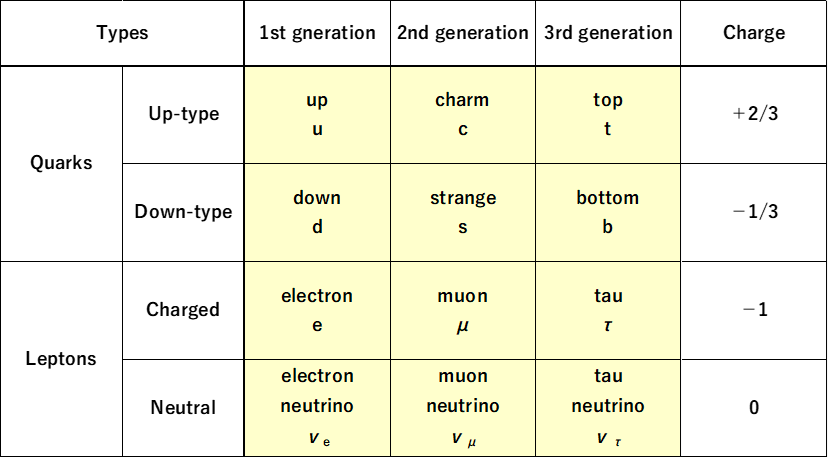
It has not been proven to be the most fundamental part of the universe, but it is currently the smallest part of the universe that we are aware of.
A closer look at the table reveals some interesting patterns.
First of all, there are two types of matter particles: “quarks” and “leptons”. The difference between them is that quarks feel a strong nuclear force, while leptons do not.
Next, the particles that make up the matter around us, such as up quarks, down quarks, and electrons, are all arranged in the leftmost row. There is one other type of particle in this row, electron neutrino (νe). These particles fly like ghosts through the universe and do not interact with almost all matter.
In addition to these four types of particles, there are other particles, and they all form similar rows. Each column has similar properties to the first (such as charge and perceived force), but with a larger mass. These columns are called “generations” and three generations have been identified to date
In addition to 6 types of quarks and 6 types of leptons, a total of 12 types of matter particles (antiparticles are counted as the same particles), there are also particles that transmit force. For example, electromagnetic force is transmitted by photons. When two electrons repel each other, they are actually exchanging photons.
At present, five types of particles that transmit force have been identified.

The 12 types of elementary particles listed in Table 1 together form a list of elementary particles that have been discovered to date. This is a concept known as the “standard model.” However, it has not yet been determined whether this is a complete list of all elementary particles. In theory, there is no upper limit to the number of elementary particles.
Next, let’s consider the purpose of these elementary particles. The matter we experience on a daily basis is made up of only the first three types (up quarks, down quarks, and electrons), but there are other elementary particles that do not have a direct function. These elementary particles may possibly consist of simpler, more fundamental particles that have not yet been discovered. If this is the case, then we can interpret the elementary particles that we recognize as being formed by the combination of more fundamental particles. The patterns and coincidences seen in the current list of elementary particles can also be explained from this perspective. It is possible that this hypothesis is accurate, but it has not been proven at this time.
As is evident from the above discussion, we have not yet fully understood the structure of even the 5% of the universe that we experience on a daily basis. Although some understanding has progressed, we have not yet fully understood why matter is formed the way it is. Although we have made a list of the parts that we think make up the universe, we cannot be sure that it is complete or not.
However, it is important to note that in order to answer fundamental questions about the universe, it is necessary to have a deep understanding of the structure of matter that we experience on a daily basis. In the process, particles and phenomena that are not directly related to everyday matter may be discovered. However, since such unexplained phenomena are also part of the universe, they are considered to have important clues for understanding the formation of the whole. If we can answer these questions, we may have a better understanding of ourselves.
Thus, in Section 1 “The birth of the universe and its composition”, I talked about the formation and composition of the current cosmic world. Here, we introduce the scientific findings that have been unraveled to date about the universe that expands endlessly and envelops the earth in which we live. It must have been felt even more strongly that the earth is a minute existence in the infinite universe, and that the macrocosm has a depth beyond human understanding.
However, the evolution of the Earth and the birth and evolution of life that have unfolded on our planet—part of the solar system situated in one corner of the infinitely vast universe—have a history that is as dramatic and astonishing as, if not more than, the grand birth and evolution of the universe itself. In the following sections, starting from Section 2, let us explore that remarkable journey.
Figures and Tables
Fig. 1 NASA’s Voyager 1 spacecraft
Wikipedia, the free encyclopedia “The Voyager Project”
(https://ja.wikipedia.org/wiki/%E3%83%9C%E3%82%A4%E3%82%B8%E3%83%A3%E3%83%BC%E8%A8%88%E7%94%BB)
Fig. 2 Pale Blue Dot: Earth as seen from the edge of the solar system
IMAGES | FEBRUARY 12, 2020 Pale Blue Dot Revisited
NASA Jet Propulsion Laboratory
Fig. 3 Timeline of hominin evolution
Britannica, Homo sapiens, Evolution, Origin
(https://www.britannica.com/topic/Homo-sapiens/Origin)
Fig. 4 History of the universe unraveled by WMAP
Timeline of the Universe
Credit: NASA / WMAP Science Team
Fig. 5 B-mode polarization in the cosmic microwave background radiation
Colin Bischoff:Cosmology Research, Center for Astrophysics, Harvard & Smithsonian
(https://lweb.cfa.harvard.edu/~cbischoff/cmb/)
Fig. 6 Matter and energy that make up the universe
“We Have No Idea: A Guide to the Unknown Universe” by Jorge Cham and Daniel Whiteson, first printing published in 2018, Riverhead Books.
Chapter 4 “Cosmic Pie Chart”
Fig. 7 A cluster of galaxies that looks like two eyes due to the influence of gravitational lensing
NASA Image and Video Library、NASA ID: PIA18794
(https://images.nasa.gov/details-PIA18794.html)
Fig. 8 Two colliding galaxy clusters
English version of the figure from the following reference, redrawn by ChatGPT
High Energy Accelerator Research Organization (KEK), Newsroom, [KEK Essay #17] Dark and Cold Ghost Matter “Dark Matter”
(https://www.kek.jp/ja/newsroom/2019/10/31/0900/)
Fig. 9 Separation into four forces
11.8: Evolution of the Early Universe, Physics, LibreTexts(https://phys.libretexts.org/Bookshelves/University_Physics/University_Physics_(OpenStax)/University_Physics_III_-_Optics_and_Modern_Physics_(OpenStax)/11%3A_Particle_Physics_and_Cosmology/11.08%3A_Evolution_of_the_Early_Universe)
Fig. 10 Type Ia supernova appeared in NGC4526 galaxy (bright dot in the lower left)
Astronomical Dictionary, Stars, Supernovae, Type Ia Supernovae
(https://astro-dic.jp/type-1a-supernova/)
Fig. 11 History of the expansion of the universe
English version of the figure from the following reference, redrawn by ChatGPT
High Energy Accelerator Research Organization (KEK), News, “Evidence of Dark Energy”
(https://www2.kek.jp/ja/newskek/2005/julaug/darkenergy.html)
Table 1 Basic matter particles
“We Have No Idea: A Guide to the Unknown Universe” by Jorge Cham and Daniel Whiteson, first printing published in 2018, Riverhead Books.
Chapter 4 “‘Basic’ Matter Particles”
Table 2 Elementary particles that transmit force
Ibid., Chapter 4, “Elementary particles that transmit force”