
Section 2 The Birth of the Earth and Primitive Evolution
Chapter 1 The birth of the solar system and its structure
1.Birth of the solar system
Our universe was born 13.8 billion years ago.
Compared to the age of the universe, the age of the solar system is shorter, about 4.55 billion years, or about one-third. This age is determined from the radiological age of the primordial meteorite that fell to Earth. In recent years, minerals such as silicon carbide and diamonds, which are presumed to be pre-solar materials, have been found in these meteorites. The age of these minerals is estimated to be more than 4.6 billion years, but no concrete dating has yet been successful. In addition, it is expected that the solar system will be heated and evaporated by the sun, which has become a red giant star in about 5 billion years, and eventually scatter as gas in interstellar space, leaving behind the outer planets.
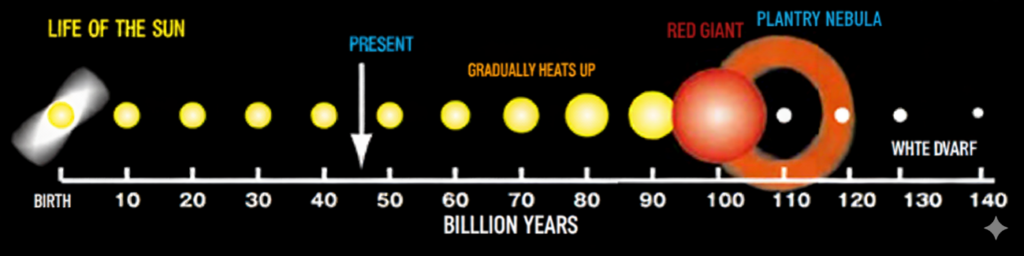
Next, let’s take a closer look at the birth process of the solar system.
In outer space, there is a region of hydrogen and a lower temperature (about 20 K) that is denser than the surrounding area. These are called “dark nebulae”, and the largest of them are called “giant molecular clouds” (Note 10). Dust and gas are present here, which are the material for the star and its surrounding planets and moons.
(Note 10) Refers to molecular clouds with a mass of about 10,000 times or more than the mass of the Sun. In giant molecular clouds, star clusters with massive stars are often formed. The nearest giant molecular cloud is the Orion A molecular cloud.
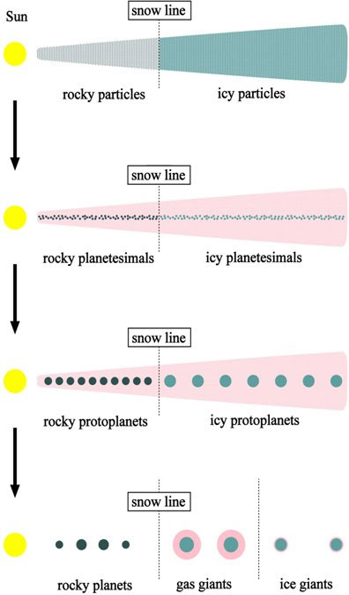
The center of the giant molecular cloud begins to shrink from the dense part, and when it exceeds a certain density, it shrinks rapidly, and a primordial star forms in the center. This protostar absorbs the dust and gas around it and grows larger, and although some of it is ejected outward and loses mass, it eventually grows into a shining star. This is a stage called the “T-Tauri star”.
The Sun and other stars are mainly composed of hydrogen and helium gases. For this reason, 99% of the “protoplanetary disk” is made up of gas, and about 1% of solid matter exists in it as micrometer-sized dust. Places with high temperatures close to the star mainly produce iron and rock dust, and ice dust is also present in places far from the star. The lower temperature limit of the orbit in which ice dust appears is called the “snow line.” These dust particles repeatedly attach and merge with each other, eventually growing into a “planetesimal” of several kilometers long.
Planetesimals are attracted by each other’s gravity and repeatedly collide and merge. The larger the planetesimal, the stronger the gravity, and the larger the size, the more frequent the collision. For this reason, the process by which the pace of collision and merger accelerates, and the early size of planetesimals becomes even larger is called “runaway growth”. This runaway growth proceeds while maintaining appropriate intervals in the protoplanetary disk, and as a result, the process by which a large number of planetesimals form a small number of “protoplanets” is called “oligopoly growth”.
The size of the protoplanet is the size of Mars (about 1/10 of the weight of the Earth) near the Earth’s orbit, and ice is also present as a solid substance near the orbit of Jupiter outside the snow line, so the amount of planetesimals increases, and it grows to about 10 times the size of the Earth.
Protoplanets disrupt their orbits due to each other’s gravity, and eventually collide and merge repeatedly. This collision between protoplanets is called a “giant impact”. Taking the Earth as an example, it is estimated that about 10 Mars-sized protoplanets have grown to Earth-sized by repeated giant impacts.
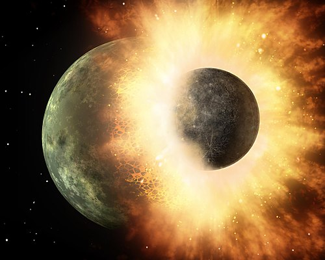
Eventually, the distance between the protoplanets will widen, and the formation of the “terrestrial planets” will be completed at the point where the collision and merger are completed. It is thought that the impact debris at the time of the giant impact is scattered around the protoplanet, and the “moon” is formed by the collection of the fragments.
As the protoplanet increases in size, it begins to attract gas in the protoplanetary disk with its own gravity. If the weight of the protoplanet is about the same as that of the Earth, the captured gas is supported by atmospheric pressure, and the protoplanet can have a stable atmosphere. However, when the protoplanet reaches about 10 times the weight of the Earth, the gravity is too strong to support the captured gas at atmospheric pressure. As a result, a large amount of gas in the protoplanetary disk flows into the protoplanet, and the inflow does not stop until all the gas around it disappears, forming a “gas giant” (a “Jovian planet)”.
In addition, the formation of protoplanets is slow in places far from the star, and the gas in the protoplanetary disk has already disappeared when the protoplanet is completed, which is about 10 times that of the Earth, and as a result, it is believed that a “giant ice planet” without a gaseous envelope — that is, a “Uranus-type planet” — is formed.
2.Structure of the solar system
The universe is believed to have started its expansion with the Big Bang about 13.8 billion years ago. This vast universe is made up of countless “microcosms”, which are moving at high speed to the ends of the universe. Within these myriad microcosms is the galaxy, including our solar system. The “Milky Way” is a spiral-shaped rotating disk with a thin cross-section with a slightly swollen center. According to current scientific knowledge, there is a “black hole” at the center.
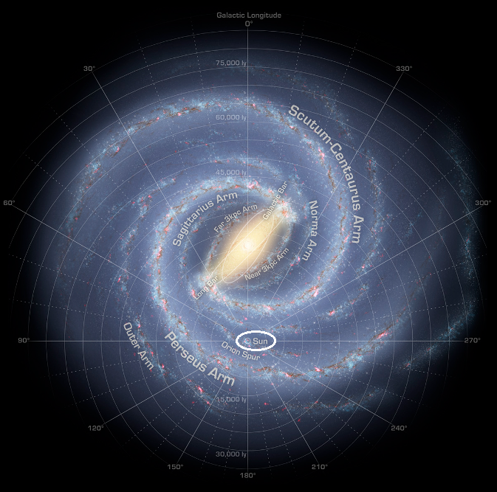
based on observational data
The solar system is located in the part of the arm that extends from the spiral structure of the galaxy, close to the edge of the galaxy. The solar system oscillates slightly up and down the equatorial plane of the galaxy with a period of about 30 million years while orbiting the galaxy. The galaxy itself rotates every 2~300 million years, and all its components, including the Earth, rotate with respect to the center of the galaxy at a cycle of 2~300 million years. Based on this fact, it is thought that the Earth has already orbited galaxies about 20 times since the formation of the solar system.
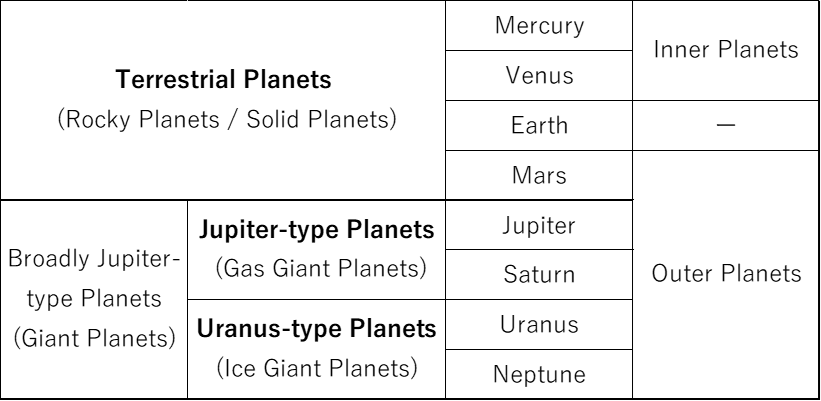
Celestial bodies orbiting the Sun include “eight planets” (Table 3), “five dwarf planets” (Note 11), “satellites” orbiting them, and smaller “asteroids”, “meteorites”, and “comets”. Each of these celestial bodies has its own period and orbit, and revolves around the Sun.
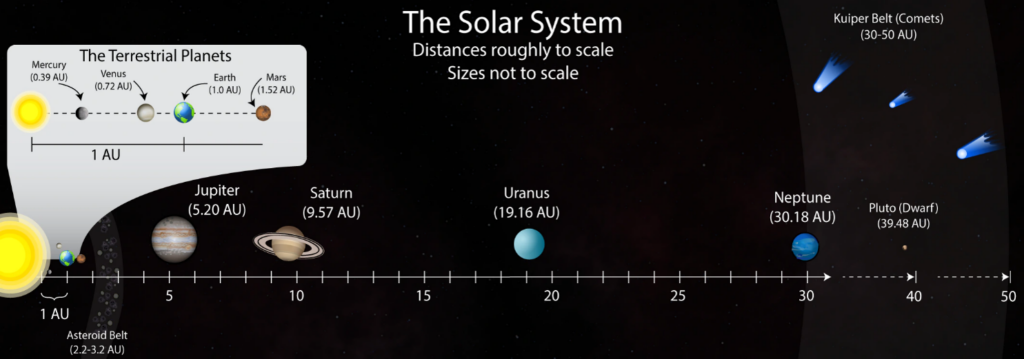
(Note 11) In the Solar System, five dwarf planets are known: “Pluto”, “Eris”, “Ceres”, “Makemake”, and “Haumea”. Pluto is a dwarf planet orbiting outside Neptune and was once considered a planet, but was reclassified as a dwarf planet as a result of a review of the definition of a planet at the International Astronomical Union General Assembly in Prague in 2006. Eris, Makemake, and Haumea, like Pluto, are dwarf planets orbiting outside Neptune, while Ceres is a dwarf planet located in the asteroid belt between Mars and Jupiter.
The planets of the solar system can be divided into three categories: “terrestrial planets” that encompass Mercury, which is closest to the Sun, Venus, Earth, Mars, and their outer asteroid belts, “Jovian planets” that encompass Jupiter and Saturn, and “Uranus-like planets” that encompass Uranus to Neptune and Pluto outside Uranus, that is, “ice giants”. Terrestrial planets are composed of metals for 1/2 of the radius from the center and rocks for the outer 1/2. Jovian planets have a small rocky core in the center and are surrounded by hydrogen. Uranus-type planets do not have a gas layer.
The “asteroid belt” is located between the inner terrestrial planets and the outer Jovian planets. The asteroid belt is made up of more than 10,000 asteroid fragments that failed to become large planets. The reason why this region could not become an Earth-like object is thought to be related to the gravitational pull of Jupiter’s massive presence on the outside, but the details are not yet clear. The groups of celestial bodies that make up the asteroid belt are divided into several groups, each of which orbits the Sun in its own elliptical orbit. As a result, meteorites periodically fall on Earth, occasionally intersecting with the Earth’s orbit.
In addition, there are “comets” that are mainly composed of ice and contain small rock fragments. These comets resemble the shape of a “dirty snowman” and revolve around the Sun in a long elliptical orbit. When a comet approaches the Sun, the solar wind blows water vapor away from the Sun, which is observed from Earth as a long tail. This is the origin of the comet’s other name “broom star”.
It has long been estimated that there are many more celestial bodies further outside Pluto. The area is called the Kuiper Belt (Note 12) after the Dutch astronomer who first predicted its existence. The Voyager probe and the Hubble Space Telescope have discovered new objects from here. In this region, the formation of planets, which began in the vicinity of the Sun about 4.55 billion years ago, is still ongoing, albeit very slowly. For this reason, this region is an important area where new discoveries are expected.
(Note 12) The Kuiper belt is a disc-shaped belt consisting of small icy bodies that exist outside the orbit of Neptune and orbit the Sun. It is also known as the “Edgeworth-Kuiper Belt” and is named after the Dutch and American astronomer Gerald Kuiper and the Irish astronomer Kenneth Edgeworth. It consists of hundreds of millions of small bodies that are thought to have been left behind when the exoplanets were formed, and they exist almost on the orbital plane of the solar system. It is considered to be the source of many short-period comets, especially those with orbital periods of less than 20 years, and icy centaur asteroids orbiting in the giant planetary region.
Chapter 2 Primitive evolution of the Earth
1.The Birth of the Earth
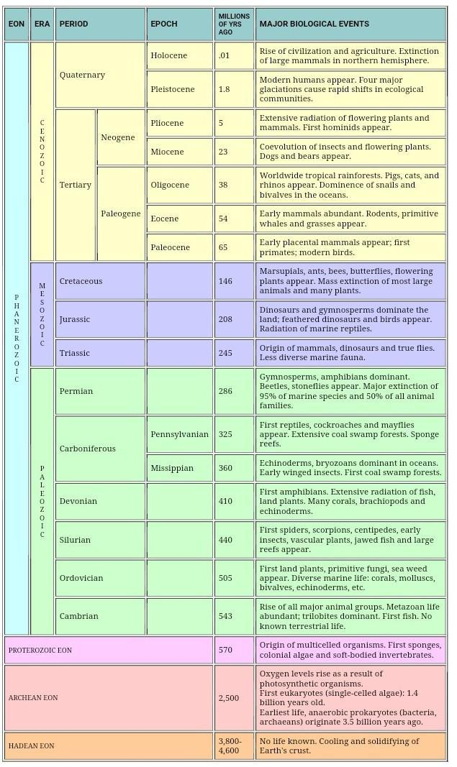
The Earth’s 4.56 billion years of history can be roughly divided into four periods.
- 4.56~4 billion years ago, the “Hadean Eon” (It means a time when there are no records left in the rocks and geological formations of the earth.)
- 4~2.5 billion years ago, the “Archean Eon”
- 2.5~0.55 billion years ago, the “ Proterozoic Eon”
- The last 0.55 billion years of the “Phanerozoic Eon”
Geological times other than the Hadean Eon are further subdivided into a number of strata. For example, the Phanerozoic Eon is further divided into three eras: the Paleozoic, the Mesozoic, and the Cenozoic, and the Paleozoic Era is further divided into six periods: Cambrian, Ordovician, Silurian, Devonian, Carboniferous, and Permian. The period before the Phanerozoic is sometimes referred to as the “Precambrian Period”, and although it is omitted here, each period is further subdivided.
Throughout the history of the earth, it is clear that the earth has not gone through constant changes to reach the present. The Earth, which was once a fireball, has been continuously cooled in space, but the method of cooling has not been constant. The release of heat from the Earth’s interior and the movement of matter within the solid Earth occurred irregularly, and the Earth occasionally cooled by rapidly releasing internal heat. In the process, rapid changes have caused significant changes in the structure and composition of the Earth’s interior, atmosphere and oceans, and upper atmosphere.
In some cases, the changes were of such a nature that they were irreversible and would never return to the same state.
If we were to name the most important events in the history of the earth, such irreversible events would be discussed. The main incidents can be summarized in the following seven categories.
- The formation of the basic stratified structure of the Earth by the collisional addition of planetesimals (4.56 billion years ago)
- The beginning of plate tectonics, the birth of life, and the beginning of the formation of the continental crust (4 billion years ago)
- The birth of a strong Earth’s magnetic field and the advance of oxygen-generating photosynthetic organisms into shallow waters (2.7 billion years ago)
- The first supercontinent formed (1.9 billion years ago)
- Infusion of seawater into the mantle, birth of the Pacific superplume and emergence of hard skeleton organisms (750~550 million years ago)
- Mass extinction of organisms at the boundary between the Paleozoic and Mesozoic eras (250 million years ago)
- The Birth of Mankind and the Beginning of Science (5 Million Years Ago ~ Present)
It was through these major events that the current Earth was formed. First, we need to look at how it evolved in that primordial era.
4.56 billion years ago from now, the “primordial Earth” was born in the newly-born primordial solar system.
Small meteorites formed by the solidification of dust in the protonebula gathered one after another to form “planetesimals” with a diameter of about 10 kilometers, and the planetesimals collided and merged repeatedly, and it grew larger like a snowball. In the final stage, they grew into a Mars-sized object called a “protoplanet,” which collided with each other and grew into a larger, Earth-like “rocky planet.” Such collisions between protoplanets are called “giant impacts” and are thought to have been experienced multiple times by Earth and Venus. This is how the primordial earth was created.
Even after the primordial Earth grew to a size close to the present size, meteorites left behind in the vicinity occasionally fell and opened large holes (craters) on the surface, according to lunar research. This is one side evidence that many meteorites fell during the formation of the Earth. From petrological studies of the material and age of the moon during the Apollo program, the timing of the formation of the craters, and the collected samples, it was found that the moon during the formation period was covered by a “magma ocean” (Note 13).
(Note 13) The rationale for this is as follows. The rocks in the whitish area on the surface of the Moon are the oldest, about 4.5 billion years old. It is a rock called “Anorthosite”, which is made almost exclusively of a mineral called “plagioclase”. Observations from seismographs placed on the lunar surface have shown that the lunar crust made of anorthosite is about 100 kilometers thick (the earth’s crust is less than 40 kilometers). In order to create a large amount of anorthosite formed from magma in a short period of time, a magma ocean at a depth of 200~400 kilometers is required, and there is no other way than to float and solidify plagioclase, which is lighter than magma.
The radius of the Moon is only a quarter of the radius of the Earth. The fact that a large-scale magma ocean was formed even on such a small celestial body suggests that the Earth’s formation was caused by a collision and merger of planetesimals on a much larger scale than the Moon. As a result, it is presumed that the Earth has also experienced a large-scale magma ocean stage.
Also, if the Moon had been formed by a “giant impact”, the Earth would have become a liquid, or magma, all the way to the center at that time. The “Giant Impact Theory” is one of the theories that explains how the Moon was formed, and it is said that it was caused by a collision with the Earth by a celestial body the size of Mars at the end of the Earth’s formation period. According to this theory, the material that made up the Moon was originally the mantle of another planet that collided with the Earth, and that the separation of the chemical composition of the mantle and core had already occurred in the interior of that planet. Most of the material that collided and scattered either flew away into infinite space or fell on Earth, but it is thought that the Moon was formed in a place where the celestial dynamics happened to be well balanced. It is speculated that the Giant Impact gave an enormous amount of energy to the Earth, and the entire Earth turned into magma.
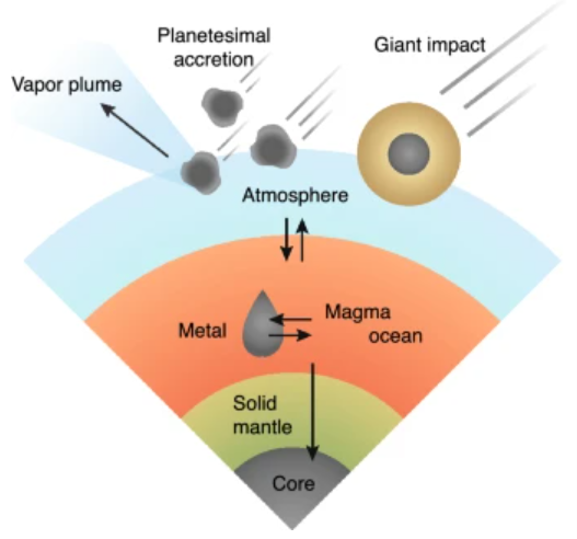
Another theory is that when a huge meteorite falls to Earth, the point of impact becomes hot, and the volatile components contained in the meteorite evaporate. The repetition of this process led to the formation of the primordial atmosphere, and its composition changed over time. On the other hand, the impact and accumulation of meteorites gradually caused the primordial earth to become larger. Then, when it grew to the size of Mars, the accumulation of impact energy and the greenhouse effect of the primordial atmosphere began to form a magma ocean, and the surface of the Earth partially melted, and iron began to separate from the rock as a liquid.
For these reasons, the prevailing theory is that the primordial earth was covered by a magma ocean. However, there are various opinions about the depth of the magma ocean. Some believe that it was more than 2,000 kilometers deep from the surface, some believe that it was much shallower, and some say that it was all magma ocean.
Since iron is heavier than rock, it sinks to the bottom of the magma ocean, cuts through the partially molten rocks of the lower mantle, and begins to collapse toward the center of the earth at once. Then, due to the gravitational energy released by the falling iron, the Earth’s interior suddenly became hot and the core began to form. Thus, 4.56 billion years ago, a “stratified structure (core, mantle, magma ocean, primordial atmosphere)” was created that is close to the present Earth.
Due to the high temperature of the earth’s surface, intense convection occurred in the thick primordial atmospheric layers. Because the primordial atmosphere is continuous with ultra-cold interplanetary space, the atmosphere (composed mainly of water vapor and carbon dioxide) cooled rapidly and became rain. The rain falling toward the ground was heated by the high-temperature magma ocean near the surface and rose as steam again.
When the lower boundary where the descending rain, cooled by the surface, turns back into vapor finally reaches the ground, it marks the birth of the “primitive ocean”. However, the date of the formation of the primordial ocean varies greatly depending on what kind of planet formation model is applied, but here we consider that the formation of a large-scale primordial ocean was about 4 billion years ago based on the evidence left on Earth.
Through the primordial atmospheric layers, the heat of the magma ocean gradually escaped into space, and its surface solidified. At that time, the Earth’s surface is thought to have been dominated by “plume tectonics” (Note 14). On Plutoic Earth, such plume tectonics dominated the first 600 million years.
(Note 14) The large-scale convective motion in the mantle is called a “plume”, and this variation is named “plume tectonics”. While the “theory of plate tectonics” deals with the variability of plates (about 100 km thick) on the Earth’s surface, this theory considers the movement of the entire mantle, which reaches a depth of 2,900km. “Tectonics” is a term used in geology to refer to the movement of the Earth and non-terrestrial planets, mainly in the lithosphere.
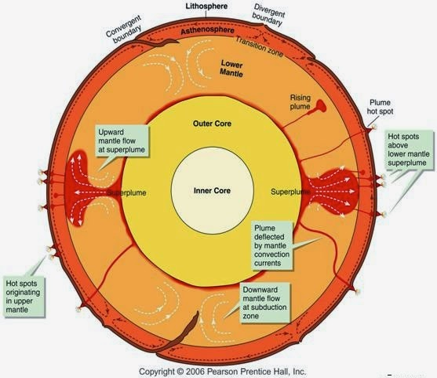
When was the solidification of the magma ocean completed? It is thought that it took 200 million years for a magma ocean to solidify, which is about 200~400 kilometers thick, even for a small celestial body like the Moon. It is presumed that the Earth, which is larger than the Moon, would have required an even longer time. Here, let’s assume that the complete solidification of the magma ocean took until about 4.3 billion years ago. In addition, if the magma ocean is deep, more than 1,000 kilometers, it is highly likely that a mantle with a different chemical composition depending on the depth was formed during the solidification process.
2.Primordial Ocean, Granite, Plate Tectonics
It is estimated that 4 billion years ago, the Earth created a “primordial ocean” and as a result, “granite” was formed for the first time. These hypotheses are based on rock information from the Acasta region of northern Canada and the Issua region of Greenland.
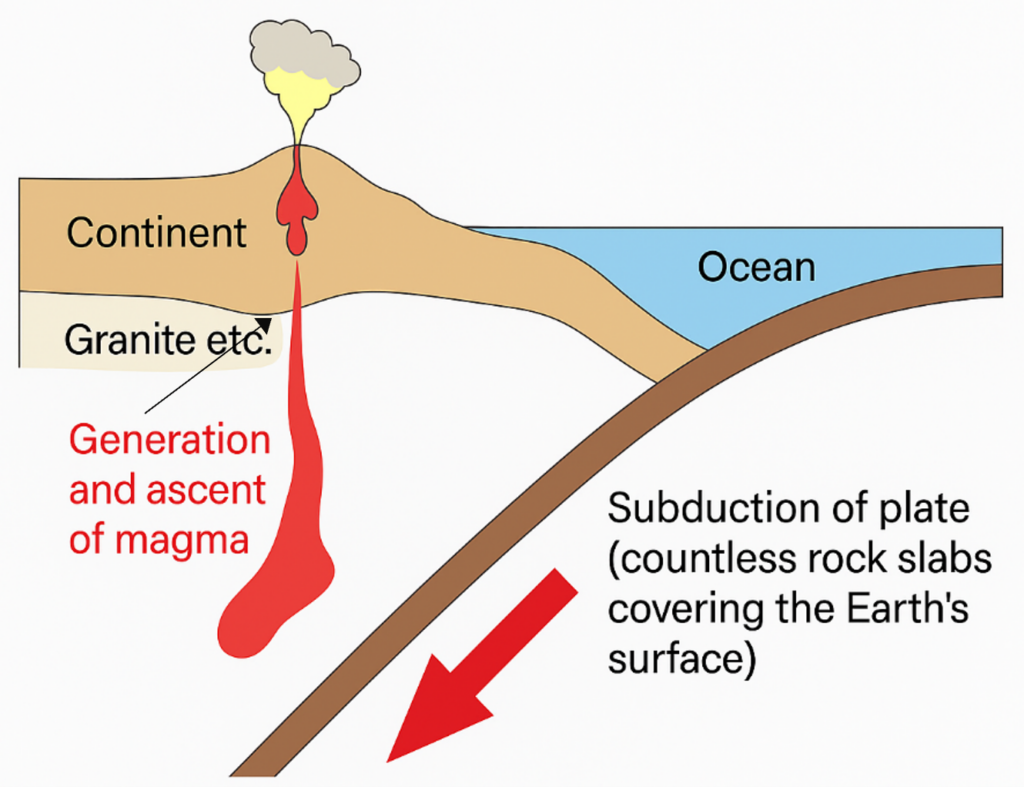
If there is no seawater on Earth’s surface, it would not be possible to melt granite even if plume tectonics subducts the surface silicon dioxide (SiO2)-poor basaltic oceanic crust into the mantle, as was the case with Venus and Mars in the past.
In the presence of seawater, basaltic crust reacts with “hydrothermal water,” which is high-temperature seawater that seeps into the earth’s crust immediately after formation, to form hydrous minerals. As a result, the temperature at which the rock melts drops significantly, and the subducted hydrous crust melts at a depth of about 30~50 kilometers to produce acidic magma rich in SiO2, which rises to the surface and becomes granite. This is the reason why a large amount of granite is produced characteristically only on Earth.
A small amount of granite can also be seen on Venus and the Moon, but it is presumed that they were formed by the crystal differentiation of basaltic magma (magma and rocks with different chemical compositions are generated as the magma cools and solidifies).
When the temperature of the earth’s surface drops to the point where seawater can exist without evaporation, the rocks in the surface layer become rigid and “plates” are formed, which is called “plate tectonics” starts to work. This rapid drop in temperature on the Earth’s surface is due to the rapid absorption of large amounts of carbon dioxide by the primordial oceans. The rapid decline of carbon dioxide in the atmosphere led to the disappearance of the greenhouse effect, making it easier for the heat of the Earth’s interior to be released into space.
As the amount of seawater in the primitive ocean increased and the carbon dioxide in the atmosphere decreased, the Earth’s surface temperature, according to one estimate, dropped rapidly from an extremely high state exceeding 1000 °C to about 130 °C within 1,000 years.
At this temperature, new plates were formed on the surface of the Earth in straight fissures (ridges) and moved horizontally to reach the trenches, where they subducted into the mantle.
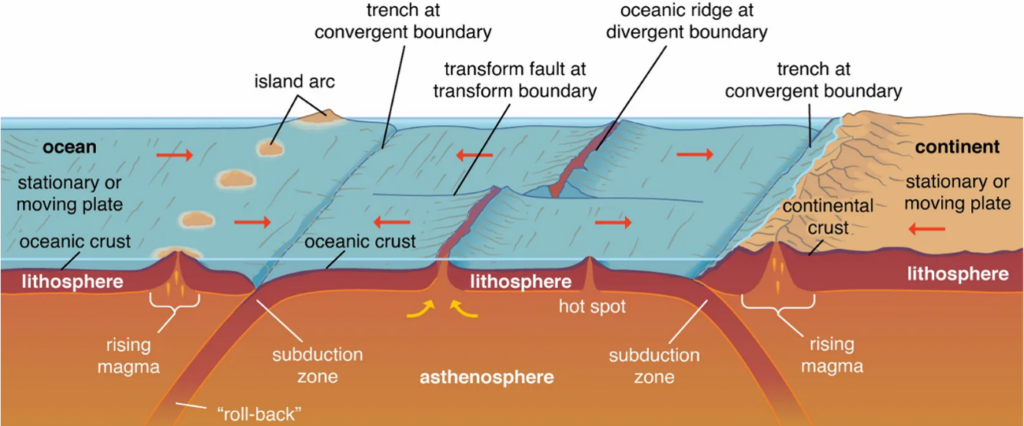
This is the causal relationship in which the three phenomena of “the birth of the primordial ocean”, “the beginning of plate tectonics”, and “the formation of granite” appeared at the same time.
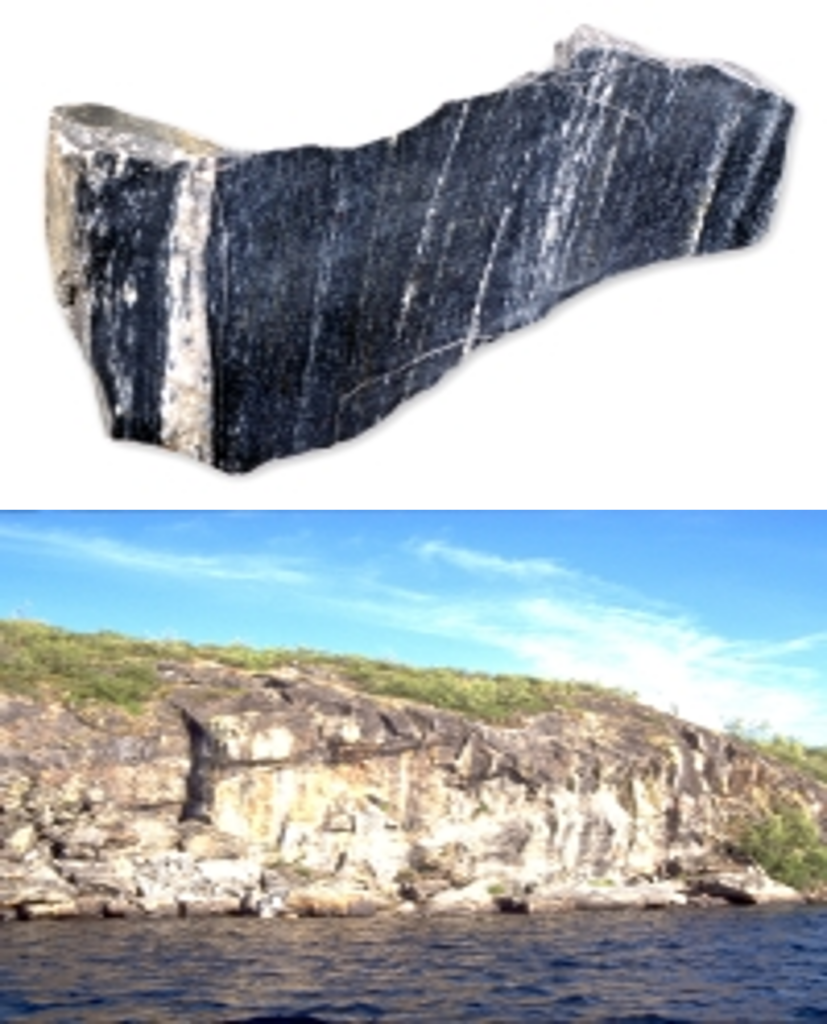
The oldest granite on earth is the aforementioned “Acasta gneiss”, which is almost 4 billion years old. In the Issua region, it is known that granite and accretionary bodies (sediments on the oceanic plate were stripped off and added to the land side when the oceanic plate was subducted under the continental plate in the ocean trench) by plate tectonics similar to that of the Earth today. In addition, the existence of “pillow lava”, which is characteristically formed when lava solidifies in water, which is direct evidence of the existence of seawater, has been confirmed.
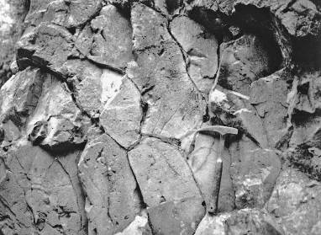
In short,
- On Earth, the primordial ocean was formed 4 billion years ago when the temperature of the surface layer dropped to the point where seawater could exist on the surface without evaporating.
- Then, because the ocean absorbed carbon dioxide, the earth cooled further, and the surface rocks became rigid from “plume tectonics” to “plate tectonics” to function.
- The oldest granite on earth is the aforementioned “Acasta gneiss”, which is indicated by its age showing a value of almost 4 billion years ago. Plate tectonics, which governs the Earth’s fluctuations, was able to move due to its fluidity and vulnerability because the lid (crust) covering the Earth contains water. On Venus, where there is no water, a rigid lid firmly solidified the crust, and only the mantle convected beneath it, so the crust (plates) did not move.
- Thus, there was seawater on Earth, and 70% of the surface became oceans. This is the crucial difference between Earth and other planets. The biggest feature is that plate tectonics has been operating since 40~3.8 billion years ago, and the oceanic crust has been altered by the medium of water brought into the Earth’s interior by subduction, and at the same time, andesitic magma is produced.
- These characteristics created the impetus for the birth of an innovative organic system called “life” on Earth, as will be described in the next part.
Finally, the characteristics of the Earth, including the information described below, are summarized as follows.
- The only planet whose surface is full of water (H2O water and ice)
- The only planet with an oxygen-rich atmosphere
- Probably the only planet with a large amount of silicon-rich rocks (granite, etc.)
- It is probably the only planet with a surface altitude distribution with two peaks (bimodal, see Figure 24), i.e., consisting of an ocean and a land
- It is the only terrestrial planet with a strong intrinsic magnetic field
- The only planet with life?
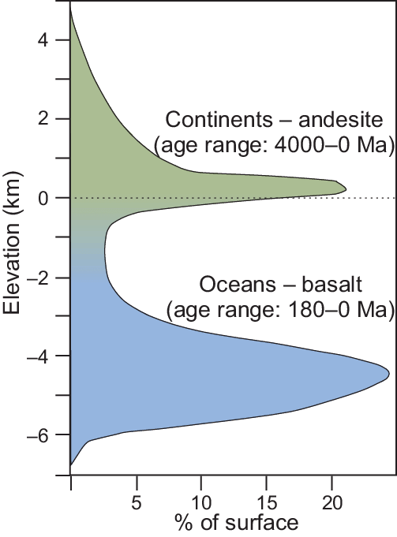
Moreover, all of these characteristics are strongly linked.
Figures and Tables
Fig. 12 The life cycle of the sun
English version of the figure from the following reference, Fig. 24 Earth’s elevation distribution: bimodalredrawn by GEMINI
“Dlaczego słońce świeci? Jakie mechanizmy stoją za blaskiem gwiazdy?”https://scroll.morele.net/Technologia(https://scroll.morele.net/technologia/dlaczego-slonce-swieci-jakie-mechanizmy-stoja-za-blaskiem-gwiazdy/)
Fig. 13 Standard scenario of solar system formation
Press Release, “Water ice in the young planetary system – future ocean of the planets?”, February 17, 2009, Subaru Telescope, National Astronomical Observatory of Japan (https://subarutelescope.org/old/Pressrelease/2009/02/17/index.html)
Fig. 14 Imaginary drawing of the Giant Impact (created by NASA)
Wikipedia, the free encyclopedia “Giant Impact Theory” (https://ja.wikipedia.org/wiki/%E3%82%B8%E3%83%A3%E3%82%A4%E3%82%A2%E3%83%B3%E3%83%88%E3%83%BB%E3%82%A4%E3%83%B3%E3%83%91%E3%82%AF%E3%83%88%E8%AA%AC)
Fig. 15 Imaginary diagram of the Milky Way of the Galaxy, based on observational data.
Astronomical Dictionary, Galaxies and clusters, Milky Way, Milky Way
(https://astro-dic.jp/milky-way-galaxy/)
Fig. 16 Composition of the solar system
Kevin’s Guides, Guides, Science, Astronomy, The Solar System
(https://kevinsguides.com/guides/science/astronomy/the-solar-system/)
Table 3 Classification of the planets of the solar system
Wikipedia, the free encyclopedia “Jovian planets”
(https://ja.wikipedia.org/wiki/%E6%9C%A8%E6%98%9F%E5%9E%8B%E6%83%91%E6%98%9F)
Fig. 17 Geologic time division
BRAINLY, Go from questioning to understanding, question/8667826, Write the significant events happened during the different eons, era, periods and epoch(https://brainly.ph/question/8667826)
Fig. 18 Formation of primitive earth stratification structure
Haruka Sakuraba, Hiroyuki Kurokawa, Hidenori Genda & Kenji Ohta “Numerous chondritic impactors and oxidized magma ocean set Earth’s volatile depletion”, Scientific Reports volume 11, Article number: 20894 (2021)
(https://www.nature.com/articles/s41598-021-99240-w)
Fig. 19 Plume tectonics
Geologyin.com, Earth, News News
How hot material is stopped in Earth’s mantle?
(https://www.geologyin.com/2015/04/how-hot-material-is-stopped-in-earths.html)
Fig. 20 Granite formation
Kami Town Geopark and Sea Culture Museum, Geopark Floor
(https://geo-umibun.jp/nihon-2/)
Fig. 21 Plate tectonics
Britannica, Science, Earth Science, Geologic Time & Fossils, Earth’s tectonic plates
(https://www.britannica.com/science/plate-tectonics)
Fig. 22 Astaka gneiss and its outcrops
Kanagawa Prefectural Museum of Life and Earth, Special Exhibition “People and the Earth”
(https://nh.kanagawa-museum.jp/kenkyu/epacs/museum4/1b02.htm)
Fig. 23 Pillow lava
Kyoto Prefectural Red Data Book 2015, Topography, Geology, Natural Phenomena, Geology, Pillow Lava
(https://www.pref.kyoto.jp/kankyo/rdb/geo/db/soi0072.html)
Fig. 24 Earth’s elevation distribution: bimodal
(https://www.researchgate.net/figure/Bimodal-distribution-of-surface-ele-vations-on-Earth-relative-to-sea-level-emphasizing_fig2_258786941)